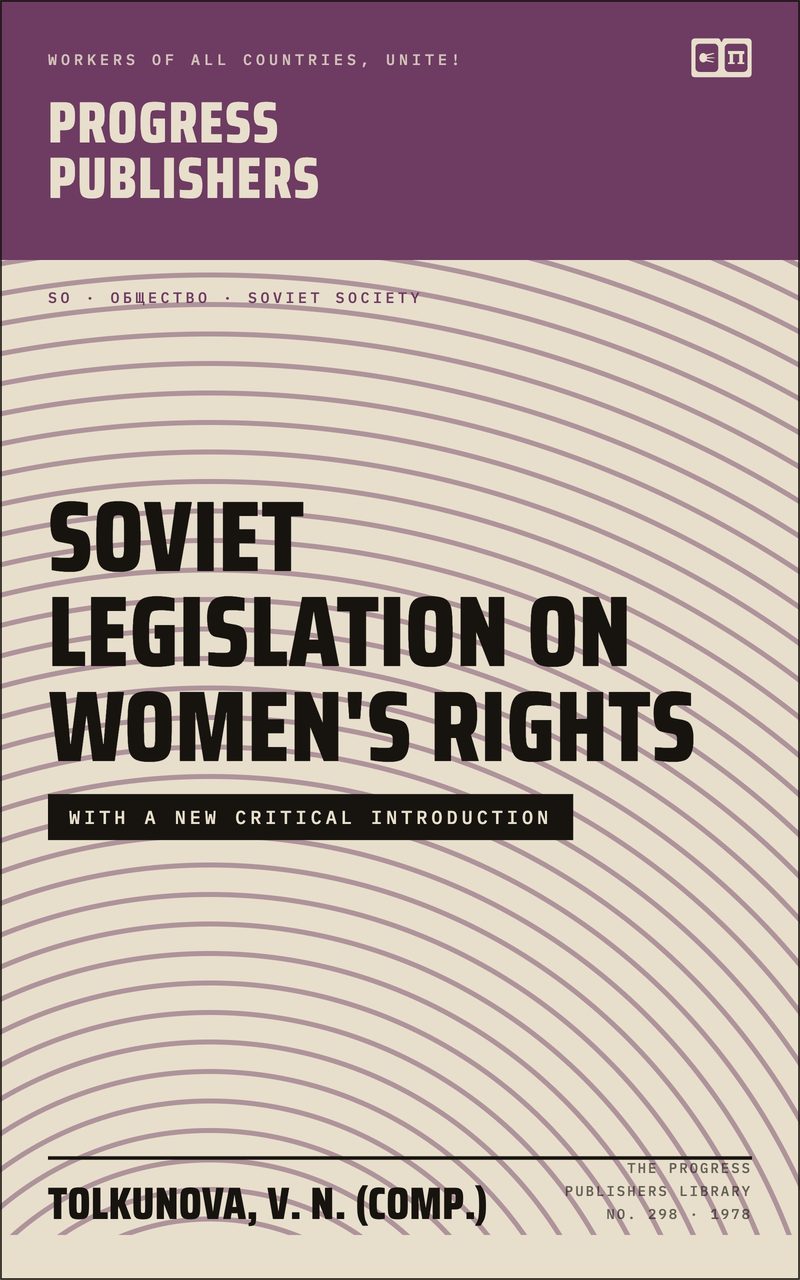
Soviet Legislation on Women's Rights
Buy
The critical introduction
Written for this edition and published free in Progress Quarterly, Volume V, Number 3.
Read it the whole numberA brief for the defence, filed in an argument the Soviet Union was conducting at the United Nations.
This is a compilation of some hundred and fifty statutes, codes, decrees, ministerial orders and trade-union instructions, mostly in extract, arranged under six headings: general provisions, maternity and child protection, women's rights in the family, labour rights, social insurance, and the international conventions the USSR had ratified. Four women jurists compiled it - A. M. Belyakova, Z. S. Beliayeva, N. N. Sheptulina and Professor V. N. Tolkunova, who wrote the preface - and its occasion was International Women's Year.
The argument is not made in prose. It is made by the weight of statute: here is the paper, inspect it. And much of that paper describes something real. By the late 1970s the Soviet Union had built provision for working mothers that most wealthy capitalist states had not - fifty-six days of paid leave before confinement and fifty-six after, extended for complicated births, with job protection, nursing breaks, restrictions on night and heavy work, and a body of family law on maintenance, divorce and the position of unmarried mothers.
For anyone researching comparative labour and family law, or the terms on which the Soviet case was put to the UN and to the Western women's movement, this is the primary documentation in one volume and in English.
The Russian original was of 1975; the English is a revised and enlarged edition carrying instruments up to 1978, including the 1977 Constitution.
Translated by Vladimir Barnashov. New critical introduction by Dmitry Chasovennikov.
| Series | The Progress Publishers Library |
| First published | 1978 |
| ISBN | 978-5-01-900303-7 |
| Pages | 216 |
| Language | English |
| Subject | Soviet Society |
| Introduction By | Dmitry Chasovennikov |
| Translator | Vladimir Barnashov |