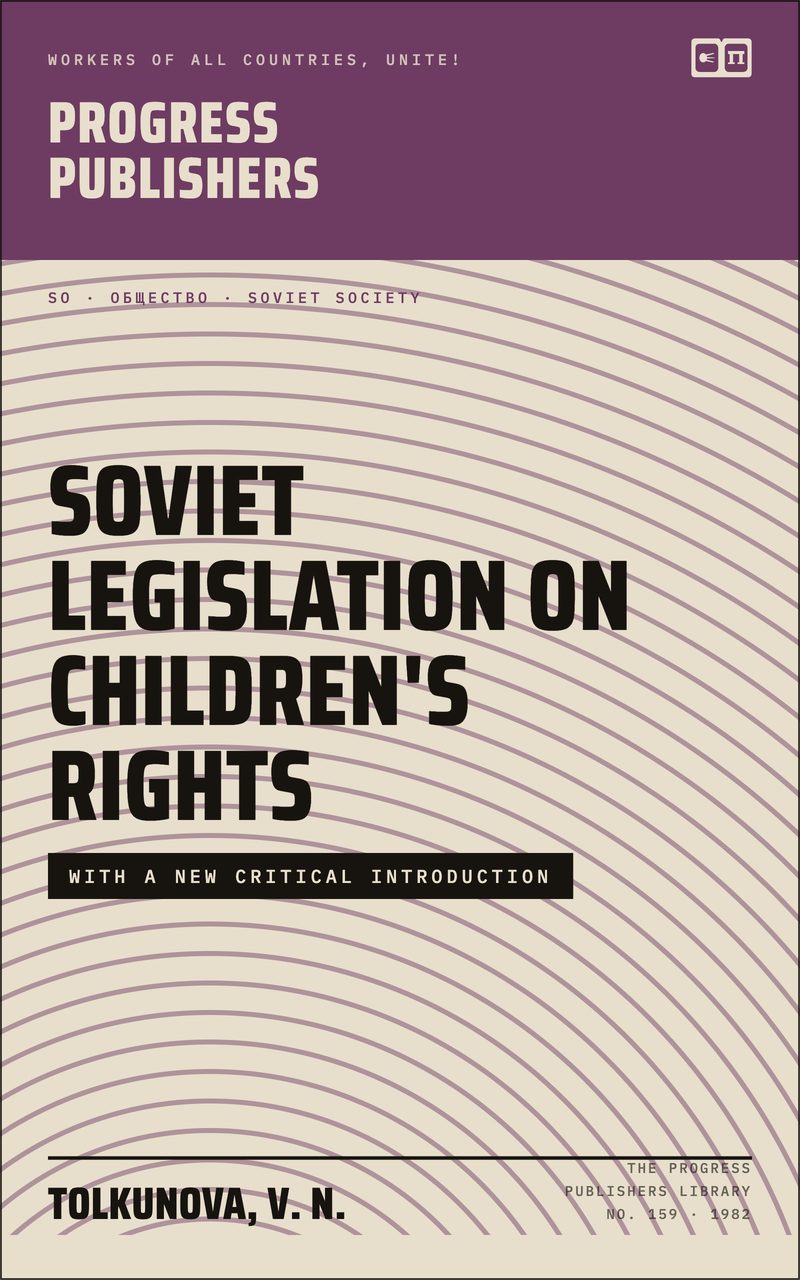
Soviet Legislation on Children's Rights
Buy
The critical introduction
Written for this edition and published free in Progress Quarterly, Volume VII, Number 2.
Read it the whole numberNot a book with an argument but a book of laws: some ninety statutes, codes, decrees and ministerial orders, given in extract and arranged under six headings - general enactments, the child within the family, the protection of childhood, the right to education and upbringing, social security, and labour privileges for adolescents.
It was compiled by two jurists of the Soviet academy, Professor V. N. Tolkunova taking the first and last sections and E. G. Azarova those between, and it presents itself as the Soviet contribution to the conversation opened by the International Year of the Child in 1979, twenty years after the UN Declaration of the Rights of the Child.
The argument is made by the weight of statute rather than in prose: here is what one state has actually legislated, laid out to be inspected. For comparative lawyers and historians of family and welfare law it is a convenient single-volume gathering of material otherwise scattered across the codes of fifteen republics, and much of what it documents - on maternity and infant care, on schooling, on the legal position of children in and outside marriage, on adolescent labour protection - describes real provision.
It belongs to a particular moment in the Cold War of paper. Helsinki had made human rights a field of superpower competition in 1975, and the Year of the Child gave Moscow a stage on which to answer not with rebuttal but with statute.
For once the date is honest: the latest instrument is a resolution of 22 January 1981 on assistance to families with children.
Translated by Jane Sayer. New critical introduction by Dmitry Chasovennikov.
| Series | The Progress Publishers Library |
| First published | 1982 |
| ISBN | 978-5-01-900123-1 |
| Pages | 191 |
| Language | English |
| Subject | Soviet Society |
| Introduction By | Dmitry Chasovennikov |
| Translator | Jane Sayer |