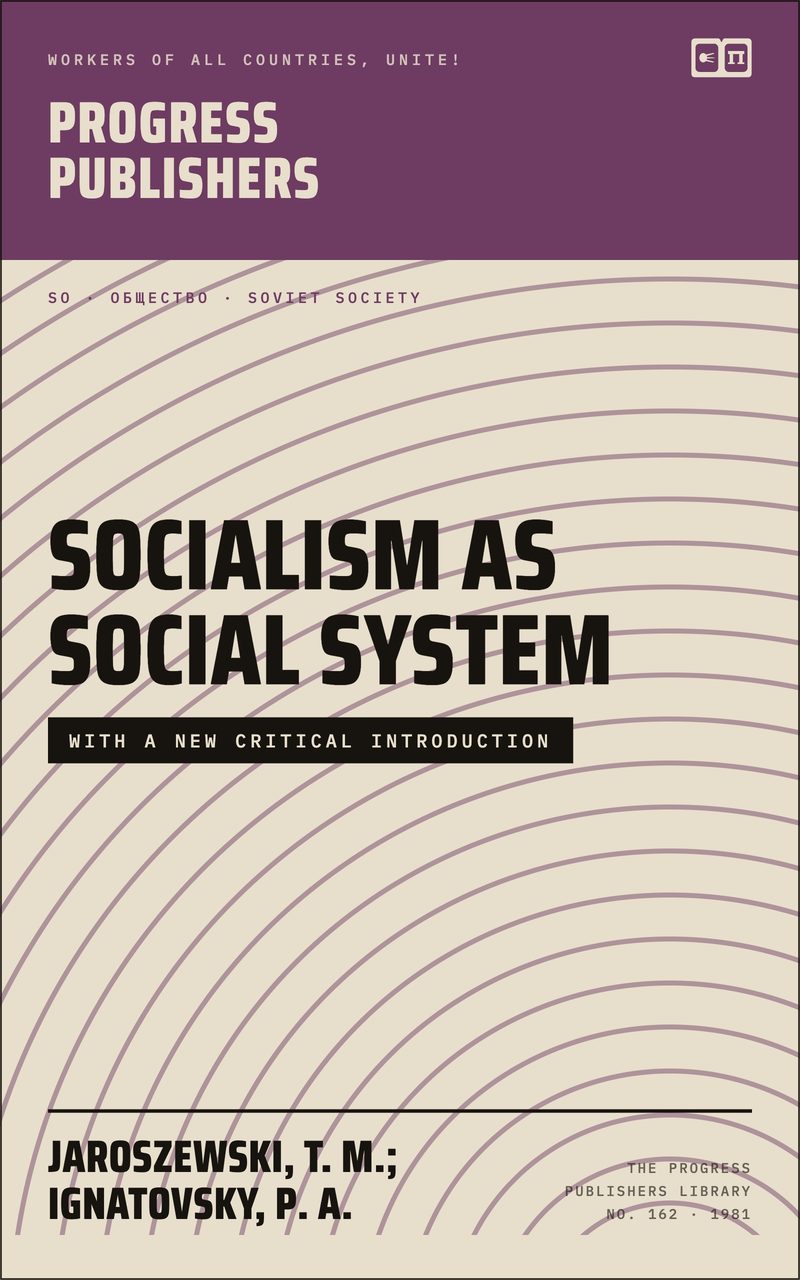
Socialism as Social System
Buy
The critical introduction
Written for this edition and published free in Progress Quarterly, Volume VII, Number 1.
Read it the whole numberA portrait of a society painted in the months that society began to come apart.
This is a collective monograph by an international team of scholars from Bulgaria, Czechoslovakia, the German Democratic Republic, Hungary, Mongolia, Poland and the Soviet Union, setting out to describe developed socialism as a finished and lasting kind of society: mature, stable, without antagonistic classes, morally and politically united.
The work was parcelled out by nation, and the division is worth knowing. The introduction, the economics, the account of the socialist community's historical role and the conclusion were prepared by Soviet teams; the Czechoslovaks wrote on the essence of socialism, the Hungarians on the political system, the East Germans on the socialist mode of life. The chapter on socialist humanism and the moulding of the new man was written by the Poles.
The editors-in-chief were T. M. Jaroszewski, a Polish philosopher of the ruling party, and P. A. Ignatovsky of the Soviet Union, and the whole was coordinated by the Institute of Basic Problems of Marxism-Leninism of the Central Committee of the Polish United Workers' Party.
So the Polish party's own theoretical institute managed a book proclaiming the settled harmony of socialist society in the very year its own working class rose against it. That is not a detail; it is the key to the volume.
The text is of 1980: its statistics stop at the close of the Tenth Five-Year Plan and its authority is the Twenty-Fifth Congress of 1976.
New critical introduction by Dmitry Chasovennikov.
| Series | The Progress Publishers Library |
| First published | 1981 |
| ISBN | 978-5-01-900126-2 |
| Pages | 448 |
| Language | English |
| Subject | Soviet Society |
| Introduction By | Dmitry Chasovennikov |
| Translator | Lenina Ilyitskaya |