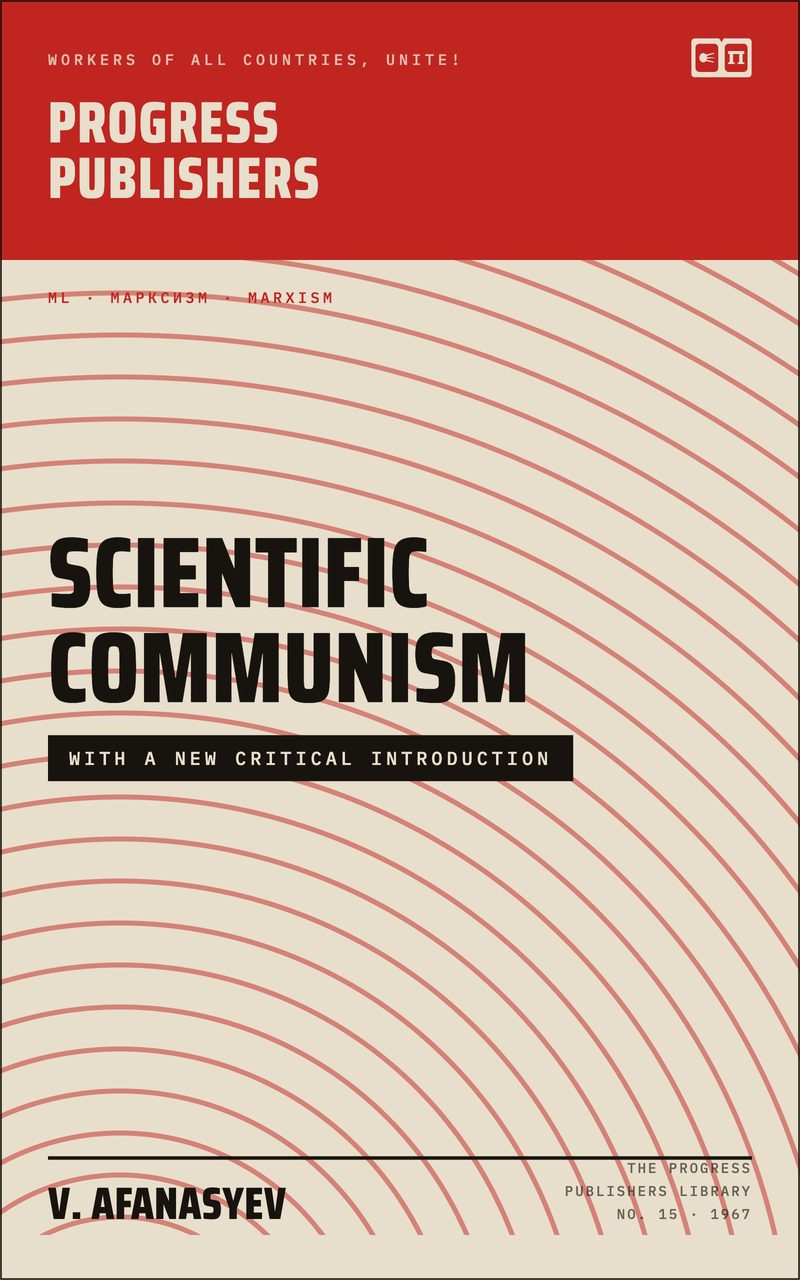
Scientific Communism
Buy
The critical introduction
Written for this edition and published free in Progress Quarterly, Volume II, Number 1.
Read it the whole numberMarxism-Leninism, as the Soviet state codified it, had three components: dialectical and historical materialism for its philosophy, political economy for its account of production, and a third discipline peculiar to the Soviet century - scientific communism, the science of the destination. This book is its primer, and its author was no minor functionary. Viktor Grigoryevich Afanasyev (1922-1994) wrote the primers of two of the three components and from 1976 edited Pravda itself.
Its value is that it catches the doctrine at its moment of maximum forward confidence. For once in this catalogue the date on the spine can be trusted: the latest event cited is the Twenty-Third Congress of April 1966, the current plan is the five-year plan for 1966-70, and "developed socialism" - the formula that would soon take the doctrine over - does not occur once. This is a jubilee book, the state's account in the fiftieth year of the revolution of where it had come from and where it was going.
When Afanasyev transmits the tradition rather than adapting it, he transmits it well. The opening history, from utopia to science, with its portraits of Winstanley, Saint-Simon, Fourier and Owen, is a competent rendering of Engels, and a student who read it would come away genuinely informed about the pre-Marxian socialists and why Marx and Engels broke with them. The two-phase theory of communism is Marx's, accurately given from the Critique of the Gotha Programme. The withering-away doctrine is Engels's and Lenin's, and Afanasyev preserves Engels's fine image of the state sent off "to where it belongs - the museum of antiquities, alongside the spinning wheel and the bronze axe."
Three chapters are then given over to the future in granular, almost loving detail: the material and technical basis of communism, automation and "the man-machine system", the disappearance of the distinction between town and country and between mental and physical labour, the moulding of the new man, and at last distribution according to need. Afanasyev can tell you how machines will be designed under communism and how leisure will be spent.
New critical introduction by Dmitry Chasovennikov, which asks what a self-described predictive science could see when it looked not forward but around.
| Series | The Progress Publishers Library |
| First published | 1967 |
| ISBN | 978-5-01-900172-9 |
| Pages | 342 |
| Language | English |
| Subject | Marxism |
| Introduction By | Dmitry Chasovennikov |
| Translator | David Skvirsky |