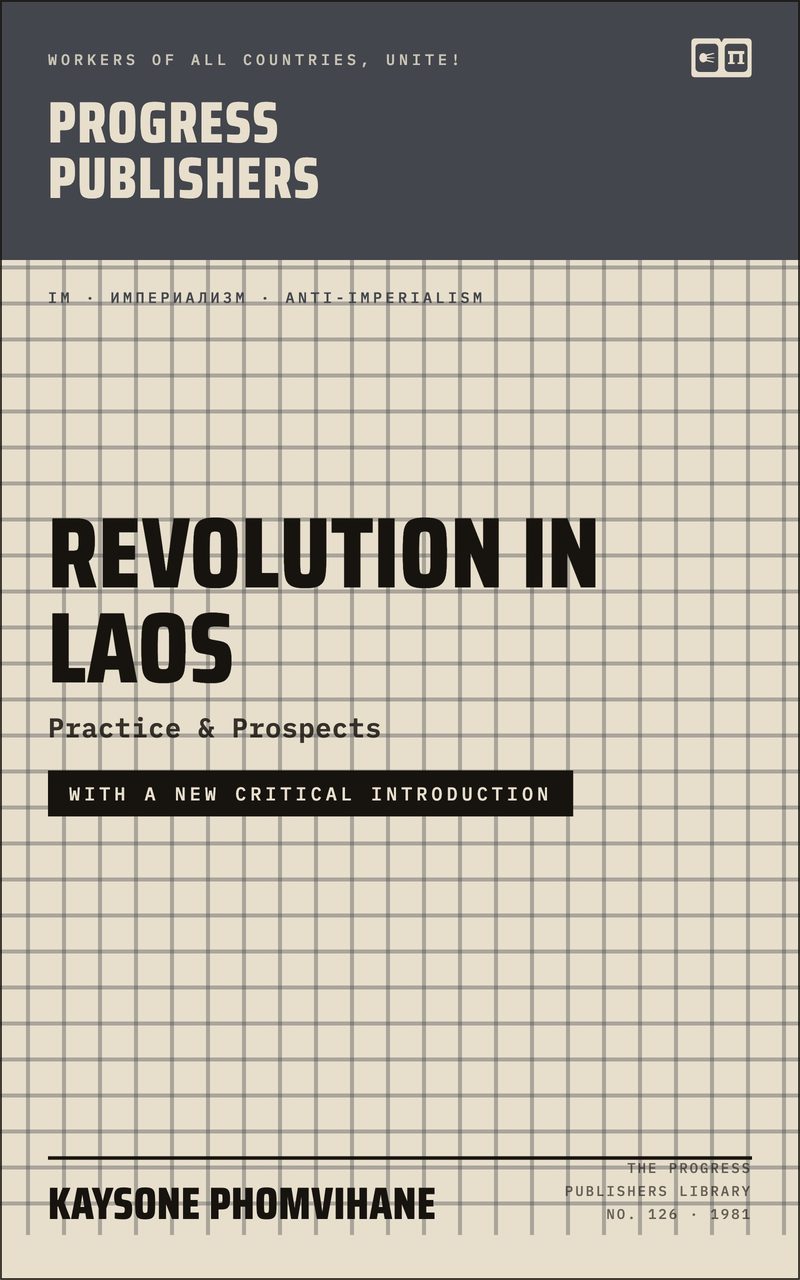
Revolution in Laos
Practice and Prospects
Buy
The critical introduction
Written for this edition and published free in Progress Quarterly, Volume VI, Number 4.
Read it the whole numberA primary document rather than a study of one.
Kaysone Phomvihane was the founding General Secretary of the Lao People's Revolutionary Party and, from December 1975, Prime Minister of the newly proclaimed People's Democratic Republic of Laos. This gathers three of his reports: a historical narrative of the long road to victory, a set of eight theoretical lessons drawn from it, and a five-part statement on building socialist Laos.
It is the authoritative self-account of one of the smallest and poorest states ever to declare for socialism - a landlocked country of a few million people, heavily bombed, with almost no industry, attempting a transition its own leader describes as advancing to socialism while bypassing capitalist development. What makes it valuable is that the difficulties are named by the man responsible for them: the shortage of cadres, the illiteracy, the weight of subsistence agriculture, the problem of a party governing a country where the working class barely existed.
The questions to ask of it are therefore not the usual ones about the historical record. They are what his own theory commits him to, what his account leaves out, and whether the categories he wields against his enemies can ever be turned toward his own new state.
The date of the argument is 1979, not the imprint year. The most theoretical report cites the Central Committee plenum of February 1977 and the party conference of January 1978, then hails the overthrow of the Khmer Rouge in January 1979 and condemns the Chinese attack on Vietnam of February and March that year.
New critical introduction by Dmitry Chasovennikov.
| Series | The Progress Publishers Library |
| First published | 1981 |
| ISBN | 978-5-01-900193-4 |
| Pages | 255 |
| Language | English |
| Subject | Anti-Imperialism |
| Introduction By | Dmitry Chasovennikov |