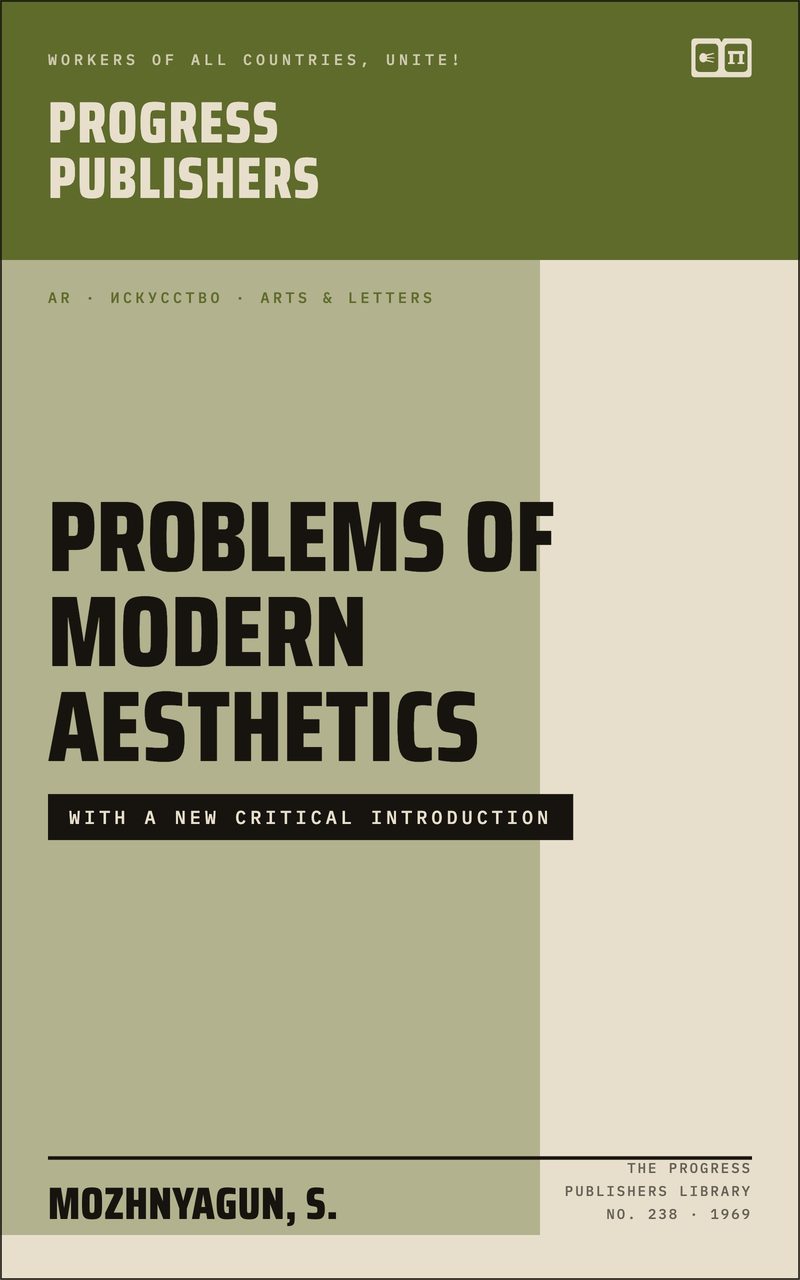
Problems of Modern Aesthetics
Buy
The critical introduction
Written for this edition and published free in Progress Quarterly, Volume II, Number 2.
Read it the whole numberThis is not a monograph but a symposium: thirteen essays by thirteen Soviet specialists, edited by Professor S. Mozhnyagun, who also contributes the longest and most combative piece in it.
A collection has to be read as a collection, and the honest thing to say is that the quality varies from essay to essay - which is itself a finding, because it tells you this is a real symposium and not a single voice in thirteen masks. Alexei Metchenko writes on the basic principles of Soviet literature; Anatoly Dremov on the ideal and the hero; Georgy Lomidze and Pavel Trofimov on the national cultures of the USSR; Nikolai Silayev on labour as a source of aesthetic feeling; Victor Romanenko on the beauty of nature; Ivan Astakhov on the origin of aesthetic feeling; Alexander Myasnikov on tradition and innovation; Mikhail Ovsyannikov on the artistic image.
It is the most openly argumentative of the Soviet aesthetics volumes of its period, and that is the reason to read it. Because it is a symposium of 1968-69 rather than a settled monograph of the seventies, it still says things the later books would learn not to say: it names Stalin and the cult, it dates the doctrine to 1932 and the 1934 Congress, and it reads Kafka and Ernst Fischer in their own words and argues with them rather than simply denouncing them.
It also carries its moment in its silences, and they are legible: it debates the aesthetics of the Prague Spring without mentioning the tanks, and dismisses Solzhenitsyn in the month of his expulsion.
Translated by Kathleen Cook-Horujy. New critical introduction by Dmitry Chasovennikov.
| Series | The Progress Publishers Library |
| First published | 1969 |
| ISBN | 978-5-01-900116-3 |
| Pages | 347 |
| Language | English |
| Subject | Arts & Letters |
| Introduction By | Dmitry Chasovennikov |
| Translator | Kathleen Cook-Horujy |