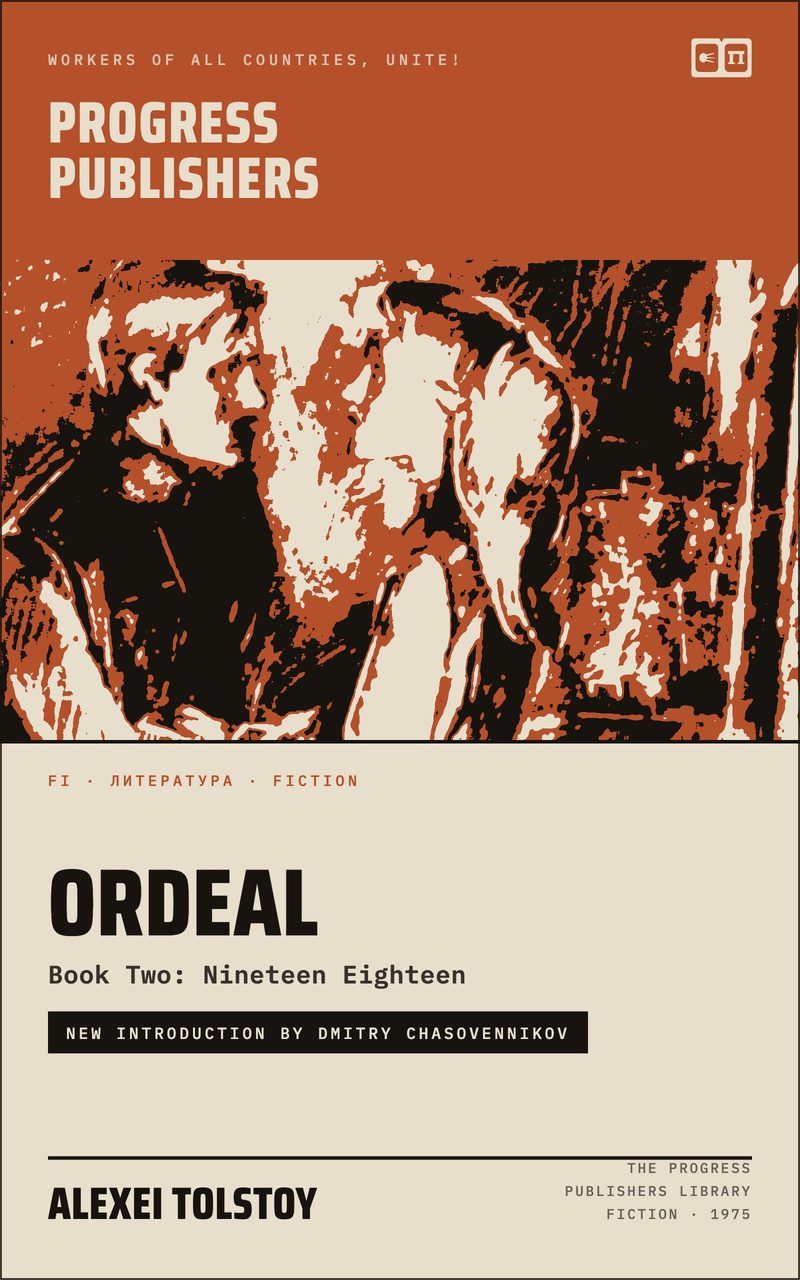
Ordeal, Book Two
Nineteen Eighteen
Buy
The removal of Trotsky from the history of 1918 survived the Twentieth Congress. It survived the removal of Stalin's body from the Mausoleum. It was still in print in 1975, and this is that printing.
In a hundred and twenty-eight thousand words about the civil war, Lenin is named fifteen times, Stalin once, and Trotsky not once. The figures are identical to the 1965 text: the same translation, the same omission, ten years on. The Revolutionary Military Council imposes its will in the passive, by a will without a person, and then a single name is supplied - Stalin, at Tsaritsyn, at a subsidiary front. Kazan happens to no one.
What stands around that silence is a very good novel. The second book of the trilogy throws the four people of The Sisters across a continent coming apart, and the best of it is the Ukraine: the Germans occupying, the atamans raiding, Makhno a rumour in the villages, nobody's authority reaching past the next set of railway sidings. An empire arrives, and what it produces is a regulation that the village street be swept on Saturday nights.
Progress Publishers, Soviet Authors Library, 1975. Translated by Ivy and Tatiana Litvinov. A 1965 Progress printing of the same translation is also reissued in this series.
New critical introduction by Dmitry Chasovennikov.
| Series | The Progress Publishers Library |
| First published | 1975 |
| ISBN | 978-5-01-900329-7 |
| Pages | 362 |
| Language | English |
| Subject | Fiction |
| Introduction By | Dmitry Chasovennikov |