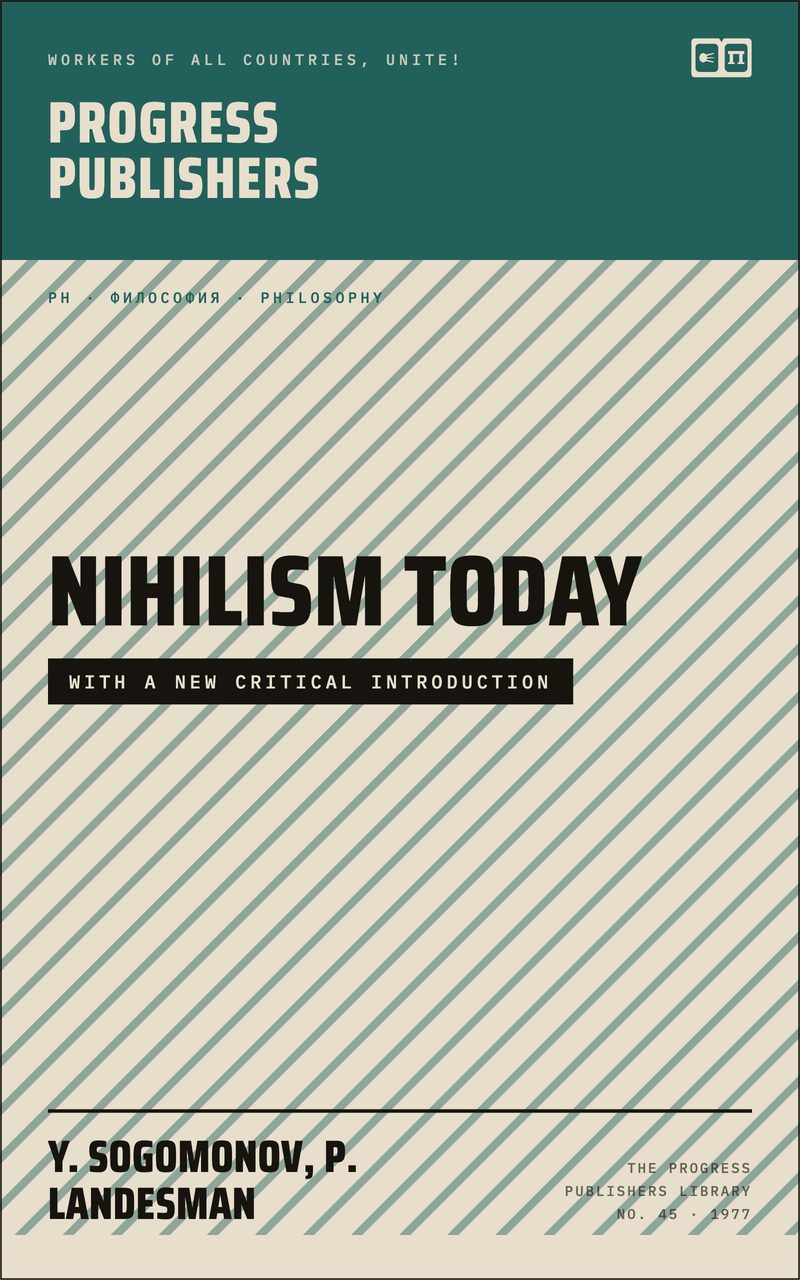
Nihilism Today
Buy
The critical introduction
Written for this edition and published free in Progress Quarterly, Volume V, Number 3.
Read it the whole numberA book about the crisis of belief is a delicate thing to publish, because the reader is entitled to ask whether the author himself believes.
Sogomonov and Landesman set out to diagnose the pessimism, disenchantment and moral vertigo of the Western world: a society in which the proclaimed values and the lived ones have come apart, official optimism is manufactured while private despair spreads underneath, and people go through the motions of a creed they no longer inhabit. It is a sharp book, and better than its worst pages.
Its strongest passages are on what the authors call the sense of contentedness - the manufactured optimism of the post-war capitalist West. Their claim is that an order unable to deliver either meaning or security produces a synthetic well-being to keep the population quiet, and that this bourgeoisification is not the literal enrichment of everyone but the manufacture of a consciousness: people who remain wage workers objectively while acquiring the outlook of small proprietors, contented, apolitical, and lost to any collective project.
They are philosophers of morals rather than denouncers with footnotes, and where they attend closely to their material they see a great deal. The chapters on absurdism, on the counterculture, and on the moral consequences of a society that has stopped believing its own official language are real phenomenology.
It was written in Moscow in 1976, as the new Constitution proclaiming unprecedented moral unity was being drafted, and at the onset of the years the country would later call the stagnation.
Translated by David Skvirsky. New critical introduction by Dmitry Chasovennikov.
| Series | The Progress Publishers Library |
| First published | 1977 |
| ISBN | 978-5-01-900188-0 |
| Pages | 228 |
| Language | English |
| Subject | Philosophy |
| Introduction By | Dmitry Chasovennikov |
| Translator | David Skvirsky |