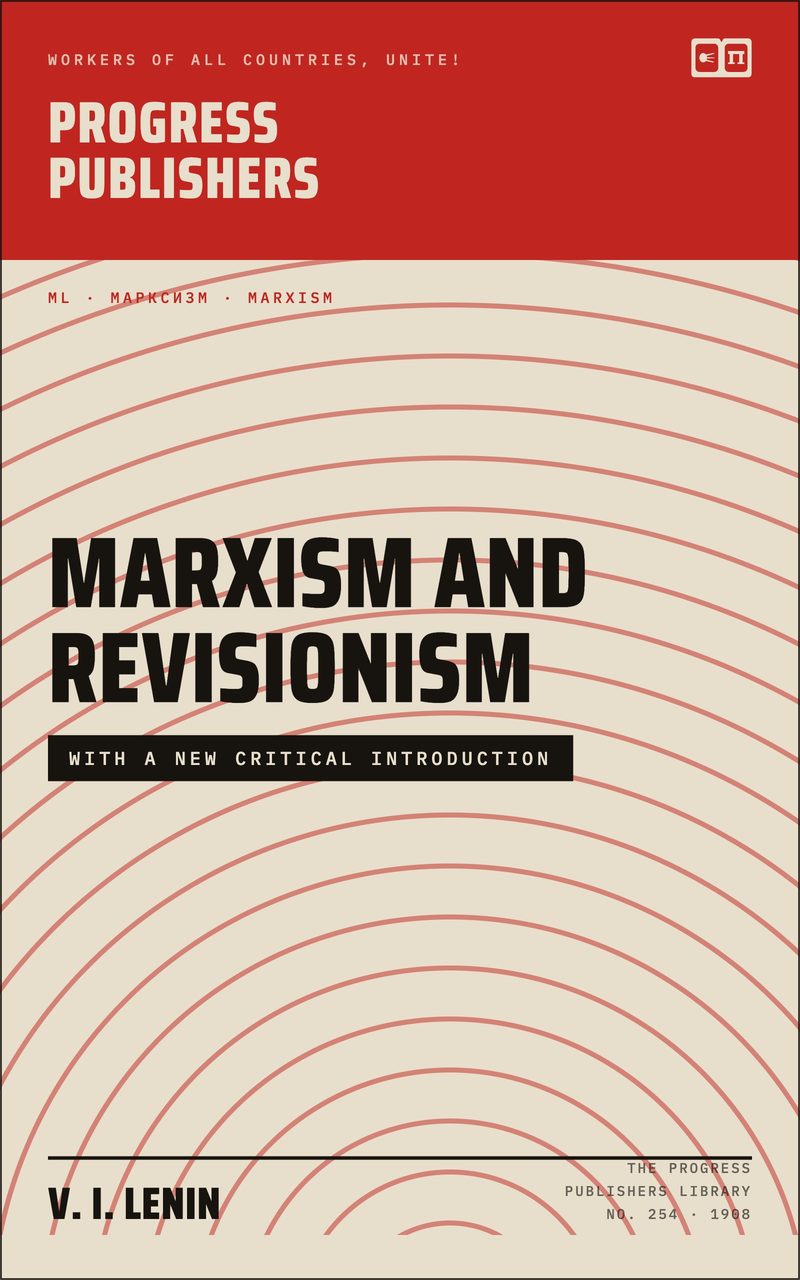
Marxism and Revisionism
Buy
The critical introduction
Written for this edition and published free in Progress Quarterly, Volume I, Number 2.
Read it the whole numberLenin wrote "Marxism and Revisionism" in the spring of 1908, for a memorial symposium published legally in St Petersburg to mark the twenty-fifth anniversary of Marx's death. The date matters twice over. It was a commemoration, and it was written in the trough of defeat: the revolution of 1905 had been crushed, Stolypin's gallows were busy, the workers' organisations were being driven back underground, and the mood among the radical intelligentsia was one of retreat.
The argument is announced by the title. Marxism, Lenin holds, has by now defeated its open rivals - the Young Hegelians, Proudhon, Bakunin, Duehring - and the moment it wins, the doctrines it beat return in disguise: no longer as enemies but as amendments from within. "Pre-Marxist socialism has been defeated," he writes; "it is continuing the struggle, no longer on its own independent ground, but on the general ground of Marxism, as revisionism." The essay tracks it across three fronts - philosophy, political economy, politics - and then asks the question that gives it its lasting value: why does revisionism keep coming back?
His answer is the part still worth arguing with. Reformism, on this account, is not a mistake to be argued away but a recurring pressure with a permanent social base, because capitalism keeps manufacturing the strata that feel it. And Eduard Bernstein's formula - "the movement is everything, the ultimate aim is nothing" - remains the epitaph of every socialism that mistakes adaptation for strategy.
It is a short piece, and an unusually clear one: Lenin writing for a legal publication and a general readership, without the polemical machinery of his factional work.
The text follows the Collected Works. New critical introduction by Dmitry Chasovennikov.
| Series | The Progress Publishers Library |
| First published | 1908 |
| ISBN | 978-5-01-900273-3 |
| Pages | 14 |
| Language | English |
| Subject | Marxism |
| Introduction By | Dmitry Chasovennikov |