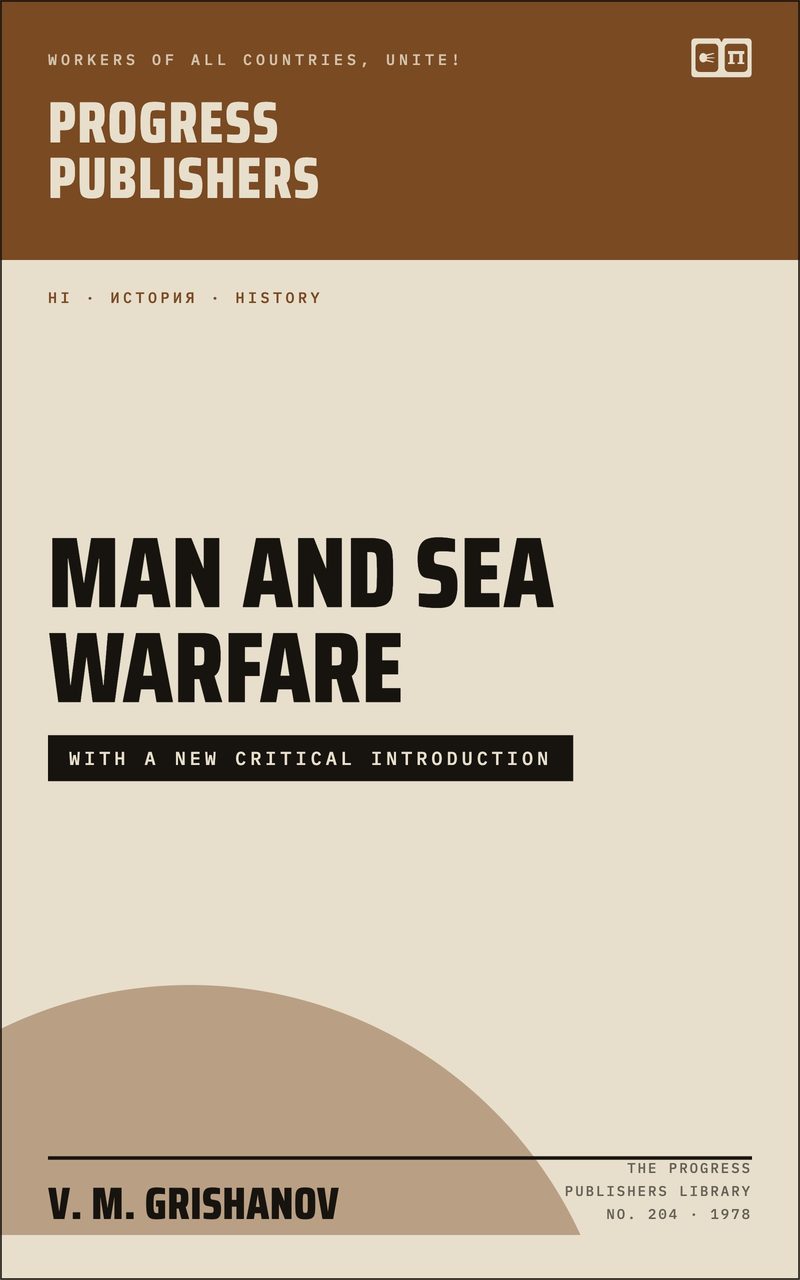
Man and Sea Warfare
Buy
The critical introduction
Written for this edition and published free in Progress Quarterly, Volume V, Number 3.
Read it the whole numberThe English title rearranges a blunter Russian original - War. Ocean. Man. That is the more honest ordering, because this is not really a book about the sea or about warfare. It is a manual for the political officers of the Soviet Navy on how to build, and keep intact, the mind of a sailor who may spend months submerged beneath an ocean he cannot see, waiting for an order he hopes never comes.
Its subject is what Soviet military writing called the human factor: morale, nerve, discipline, conviction, and the psychology of a crew under strain. There is no named author - the text refers throughout to the authors, a collective of naval political-education specialists of the kind the Main Political Administration of the Army and Navy produced in quantity.
It belongs to the high summer of Admiral Gorshkov's navy. Gorshkov had commanded since 1956 and in two decades had turned a coastal-defence force into a service with warships in every ocean: a standing squadron in the Mediterranean from 1967, a squadron in the Indian Ocean, port calls in Cuba and West Africa, a role in the sealift to Angola, and the global Okean exercise of 1970 which the book cites as evidence of its reach. Gorshkov's own doctrinal summa appeared in 1976; this is the same enterprise seen from below decks - not the strategy of the ocean-going fleet but the making of the men who crewed it.
As a window on how a superpower navy thought about its own sailors, it has no equivalent in English.
Translated by Yuri Sviridov. New critical introduction by Dmitry Chasovennikov.
| Series | The Progress Publishers Library |
| First published | 1978 |
| ISBN | 978-5-01-900087-6 |
| Pages | 225 |
| Language | English |
| Subject | History |
| Introduction By | Dmitry Chasovennikov |
| Translator | Yuri Sviridov |