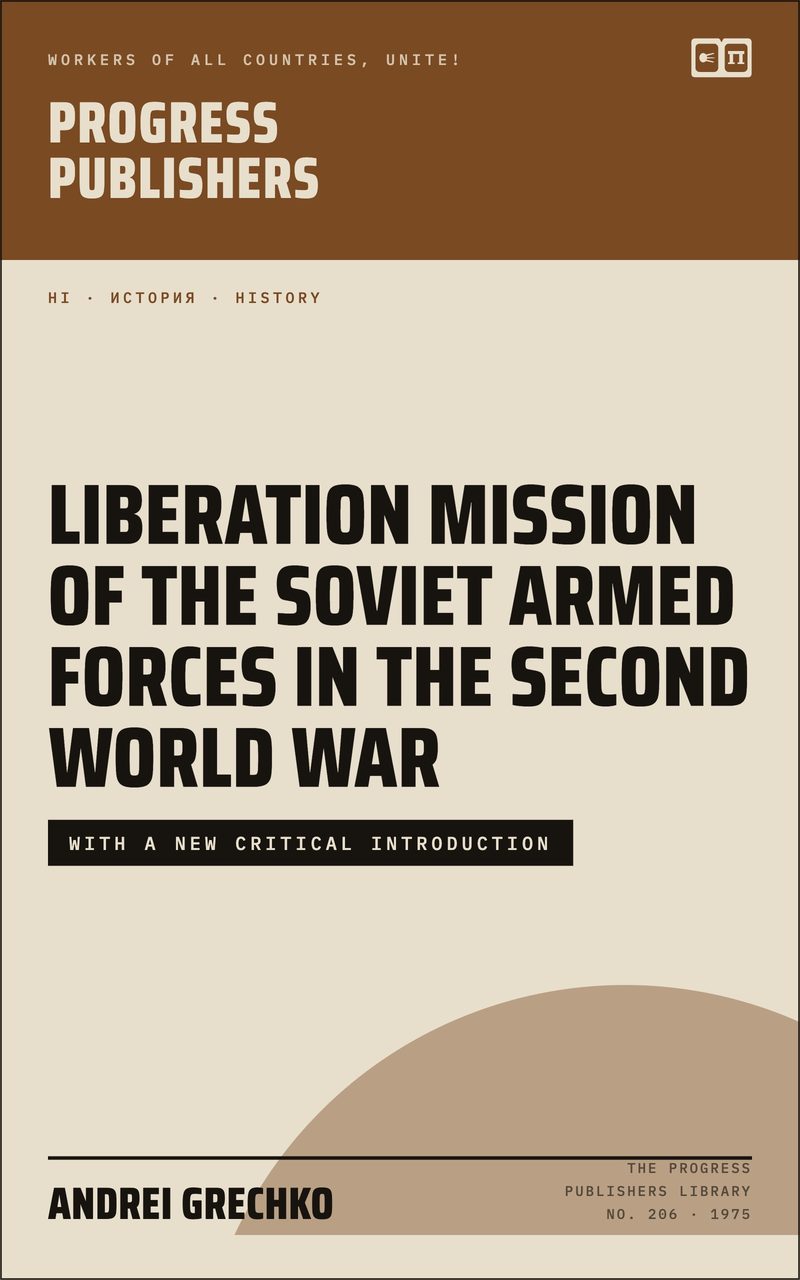
Liberation Mission of the Soviet Armed Forces in the Second World War
Buy
The critical introduction
Written for this edition and published free in Progress Quarterly, Volume IV, Number 2.
Read it the whole numberAn argument, 156,000 words long, that the Soviet soldier who marched into Poland, Romania, Bulgaria, Yugoslavia, Hungary, Austria and Czechoslovakia in 1944 and 1945 came only to liberate - and that the regimes he left behind rose from the will of the peoples he had freed.
The claim is made by a man in a position to know the difference. Andrei Grechko was Minister of Defence of the USSR from 1967 until his death in 1976 and, from 1973, a full member of the Politburo. He was the serving head of the armed forces whose conduct the book narrates and defends, writing at the apex of the Brezhnev-era military-party state, for the thirtieth anniversary of the victory.
What the Red Army did is not in dispute and the book states it with authority. Grechko is not exaggerating when he writes that the main battles of the war were fought on the Soviet-German front, where 607 enemy divisions were destroyed, routed or taken prisoner - almost three and a half times the number accounted for on all other fronts together - while Anglo-American forces in Africa and Western Europe smashed or captured 176, and that the Wehrmacht took 80 per cent of its casualties in the east. These proportions are broadly what the historiography records. It was Soviet soldiers who reached the death camps first, and the Soviet death toll given here, twenty million, has since been revised upward rather than down.
As the official war memorial of the Soviet high command, issued for export by the minister himself, nothing else states the case with this standing.
New critical introduction by Dmitry Chasovennikov.
| Series | The Progress Publishers Library |
| First published | 1975 |
| ISBN | 978-5-01-900206-1 |
| Pages | 490 |
| Language | English |
| Subject | History |
| Introduction By | Dmitry Chasovennikov |
| Translator | David Fidlon |