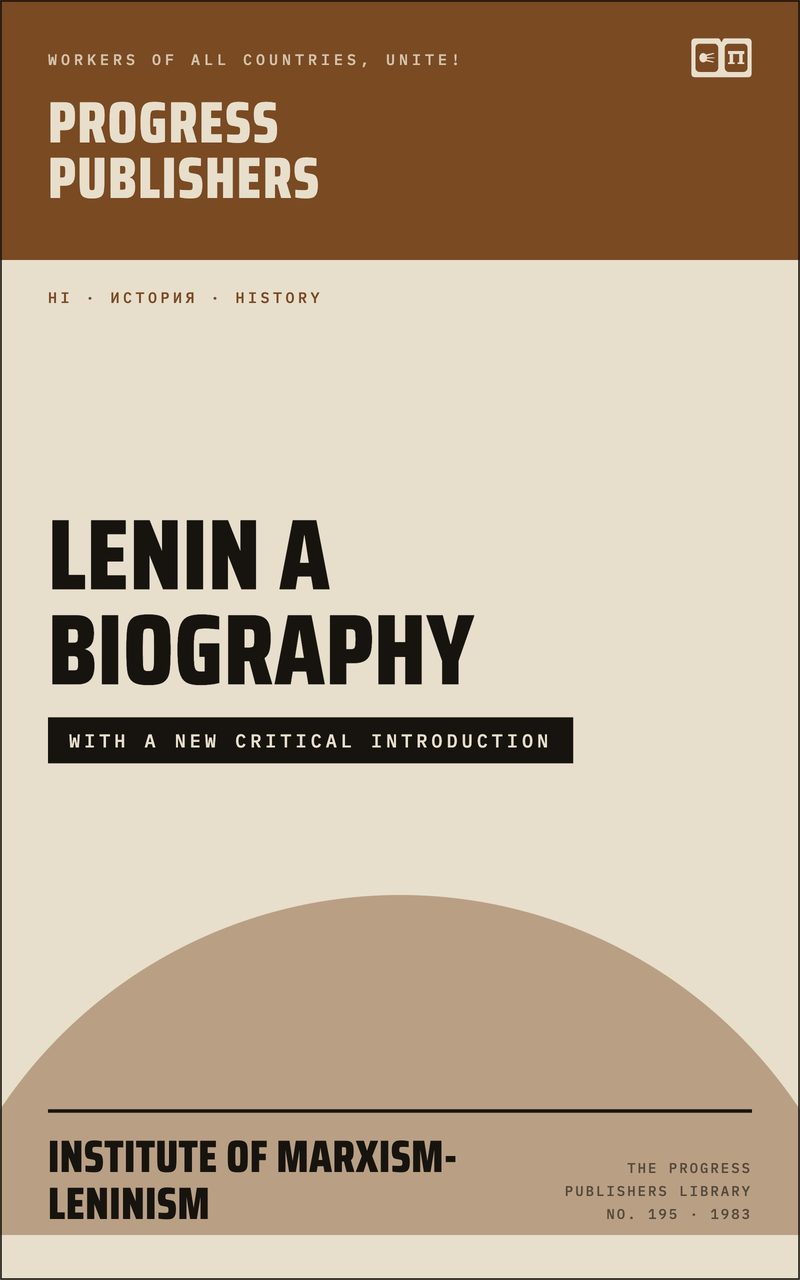
Lenin: A Biography
Buy
The critical introduction
Written for this edition and published free in Progress Quarterly, Volume VII, Number 4.
Read it the whole numberThe official life: two hundred thousand words, fourteen chapters, and a name index of some three hundred entries, prepared by the research institute attached to the Central Committee and issued in English for the world.
No author is named, because there is no author. The publishers' note runs to four lines and says only that the translation was made from the Russian text prepared by the Institute of Marxism-Leninism. This is the canonical Soviet Lenin in his most finished state, every sentence weighed and nothing left to accident, which is precisely what makes it worth having: it is the authorised version against which every other account had to argue.
It should not be dismissed as hagiography and set aside, and for a specific reason. This is not the 1938 Short Course. Stalin had been dead thirty years when it was printed, the Twentieth Congress had happened, and the institute was working under constraints that had loosened in some places and tightened in others. The result has unusual analytical value, because the book must narrate the last two years of Lenin's life, when his own writing turned against the apparatus that would canonise him. Those texts were published in the Soviet Union and known everywhere by then, so they cannot be avoided - and watching how they are handled, sentence by sentence, is worth more than any denunciation. The Letter to the Congress is here, named, with its dictation described in detail from the journal of Lenin's duty secretaries.
A late-Brezhnev text in an Andropov-year jacket: its latest citation is to the Twenty-Sixth Congress of 1981.
New critical introduction by Dmitry Chasovennikov.
| Series | The Progress Publishers Library |
| First published | 1983 |
| ISBN | 978-5-01-900077-7 |
| Pages | 525 |
| Language | English |
| Subject | History |
| Introduction By | Dmitry Chasovennikov |