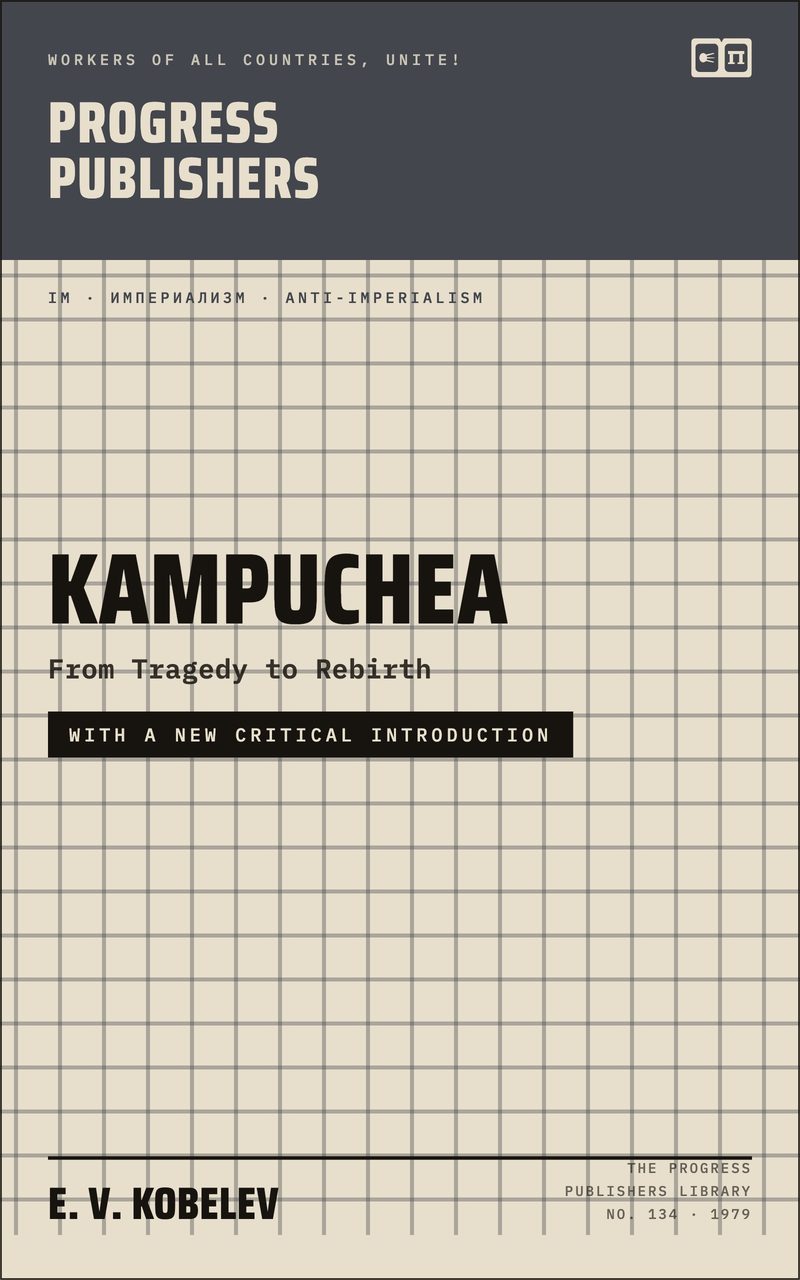
Kampuchea: From Tragedy to Rebirth
Buy
The critical introduction
Written for this edition and published free in Progress Quarterly, Volume V, Number 4.
Read it the whole numberA clippings dossier rather than a monograph: some thirty pieces of journalism, reprinted and translated, in two parts. The first gathers atrocity reporting from Cambodia under the Khmer Rouge; the second prints the founding documents of the Kampuchea United Front for National Salvation, the Manifesto of the People's Revolutionary Council, Heng Samrin's victory speech, and dispatches from Soviet correspondents newly admitted to Phnom Penh.
What it describes is true, and a reader expecting fabrication will not find much. The Khmer Rouge did empty Phnom Penh at gunpoint on 17 April 1975. They did abolish money, markets, schools, hospitals, postal services and the practice of medicine. They did work, starve and beat to death a substantial part of the Cambodian population between 1975 and the end of 1978. The Tuol Sleng interrogation centre existed, and its photographic archive survives. This was among the earliest sustained accounts available in English from a socialist publisher.
The contributors are a deliberately assorted set. Alongside the Soviet foreign correspondents - from New Times, Izvestia, Komsomolskaya Pravda - are Martha Rojas of Granma, Tiziano Terzani of Der Spiegel and Corriere della Sera, Isao Takano of the Japanese Communist Party's Akahata, Wilfred Burchett, and, most strikingly, John Barron and Anthony Paul of Reader's Digest.
It was assembled in Moscow in the first months of 1979 and published within the year. Its framing is legible in its vocabulary: Peking occurs some 143 times in roughly fifty-nine thousand words.
New critical introduction by Dmitry Chasovennikov, on the four years of silence that preceded it.
| Series | The Progress Publishers Library |
| First published | 1979 |
| ISBN | 978-5-01-900071-5 |
| Pages | 183 |
| Language | English |
| Subject | Anti-Imperialism |
| Introduction By | Dmitry Chasovennikov |