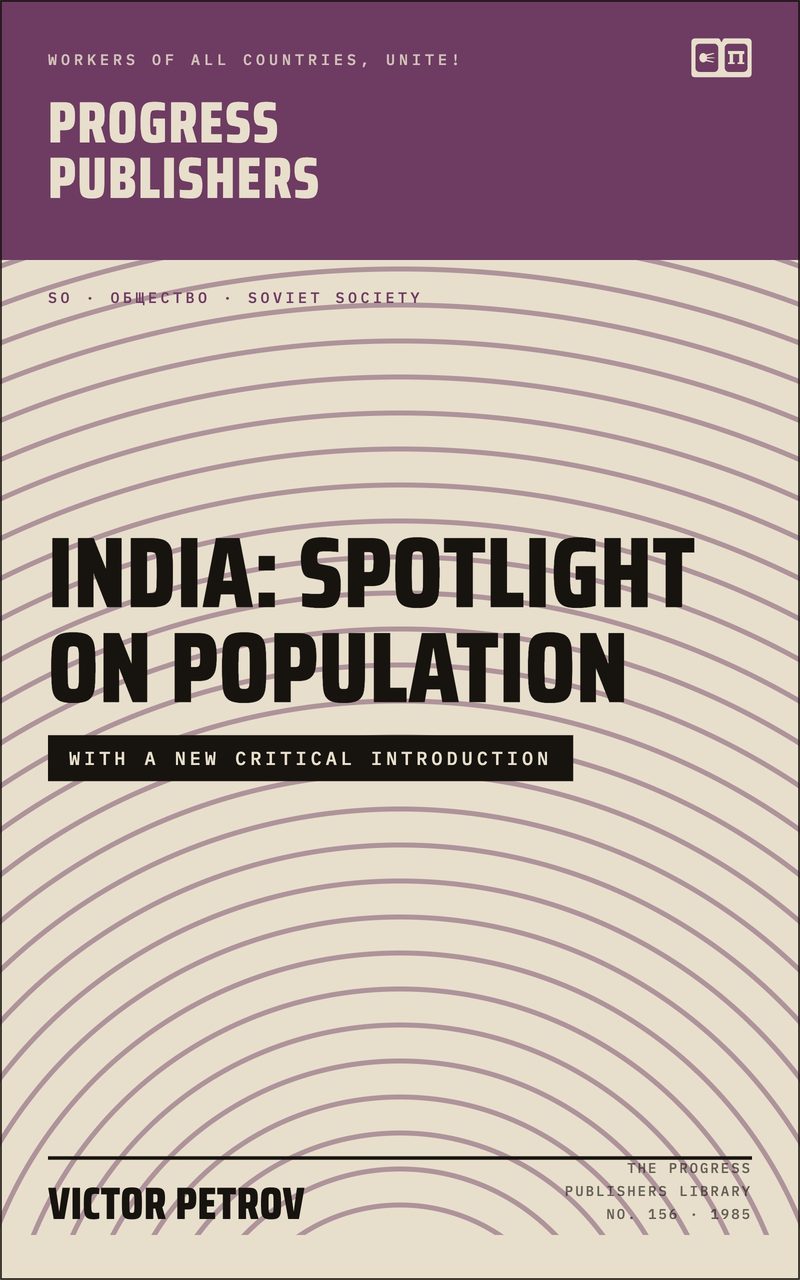
India: Spotlight on Population
Buy
The critical introduction
Written for this edition and published free in Progress Quarterly, Volume VIII, Number 3.
Read it the whole numberMost books on this list are doctrine. This one is a data set.
Victor Petrov's monograph tracks the movement of India's population from 1872 to 1981 - the run of the great Indian censuses, from the first universal counts under the Raj to the fourth taken by the independent Republic. The chapters march through size, density and distribution; national and religious composition; sex and age structure; mortality and natural increase; migration; urbanisation; literacy; and the relation of population to the economy.
Most of it is real scholarship performed with care. Petrov reconstructs India's population back through the pre-census centuries by triangulating tax rolls, army sizes, epidemic mortality and the accounts of foreign travellers. He weighs the competing estimates of Kingsley Davis against those of the Indian demographers Datta and Nath, and declines to pretend the record is cleaner than it is - noting frankly that as indirect indices multiply they grow less likely to agree. He knows the Indian census literature and the arguments over the margins of error in the 1951, 1961 and 1971 counts, and he uses them.
For anyone working on Indian historical demography, or on how the Soviet academy handled a subject where its own doctrine had strong commitments, this is a substantial and openly sourced body of material.
The latest hard data are the preliminary 1981 census and the UN forecasts revised that year.
Translated by Glenys Ann Kozlov.
New critical introduction by Dmitry Chasovennikov.
| Series | The Progress Publishers Library |
| First published | 1985 |
| ISBN | 978-5-01-900064-7 |
| Pages | 276 |
| Language | English |
| Subject | Soviet Society |
| Introduction By | Dmitry Chasovennikov |
| Translator | Glenys Ann Kozlov |