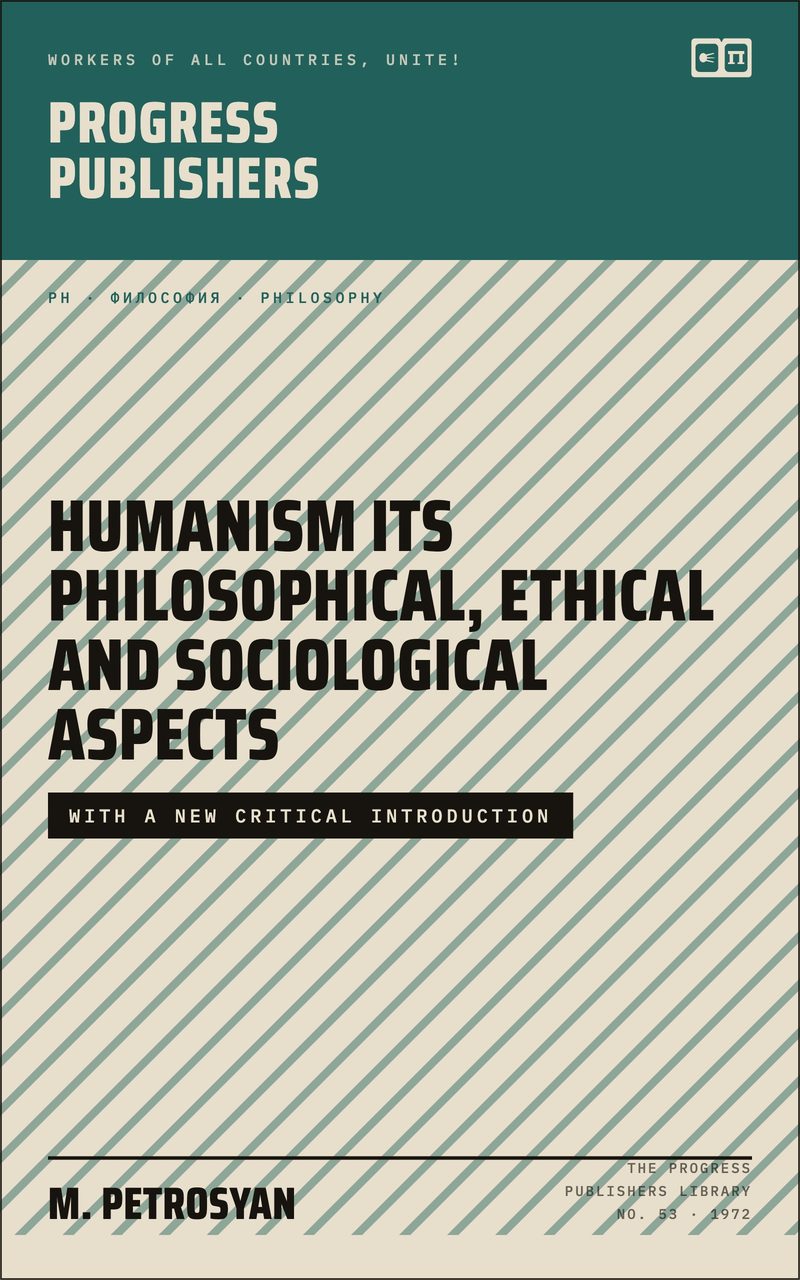
HUMANISM Its Philosophical, Ethical and Sociological Aspects
Buy
The critical introduction
Written for this edition and published free in Progress Quarterly, Volume II, Number 4.
Read it the whole numberM. Petrosyan's Humanism sets out to win an argument, and the argument is worth knowing about. Its claim is that socialism is not merely compatible with humanism but is its only genuine form, and that everything else calling itself humanist - liberal, religious, existentialist - is counterfeit.
What makes it valuable is who it argues with. The 1960s had produced, inside and outside the communist world, a revival of Marxist humanism built on the rediscovery of the young Marx and the theory of alienated labour in the 1844 Manuscripts: a Marxism about the human being rather than about iron laws of history. To Soviet orthodoxy this current was dangerous precisely because it spoke Marxism's own language, and could ask whether alienation had really ended in the USSR.
To Petrosyan's credit, he does not dismiss these figures with a slogan. He engages them by name and at length. Adam Schaff, who had argued that Marxism had simply ignored the problem of the individual, is quoted and rebutted. Roger Garaudy, then still the philosophical star of the French Communist Party, is read closely. Erich Fromm is engaged over a dozen pages on the theory of social character. The Yugoslav Praxis thinkers are quoted directly, with Gajo Petrovic's charge against the theory of reflection set down and answered. And Petrosyan fights a second front against Louis Althusser, who was expelling humanism from Marxism altogether from the opposite direction. He wants neither the revisionists' young Marx nor Althusser's anti-humanist science.
The text has two dates. Its core is a book of 1964, from the Khrushchev thaw; the revision that produced this version is anchored to the Twenty-Fourth Congress of 1971, and reads like it.
Translated by Brian Bean. New critical introduction by Dmitry Chasovennikov.
| Series | The Progress Publishers Library |
| First published | 1972 |
| ISBN | 978-5-01-900058-6 |
| Pages | 306 |
| Language | English |
| Subject | Philosophy |
| Introduction By | Dmitry Chasovennikov |
| Translator | Brian Bean |