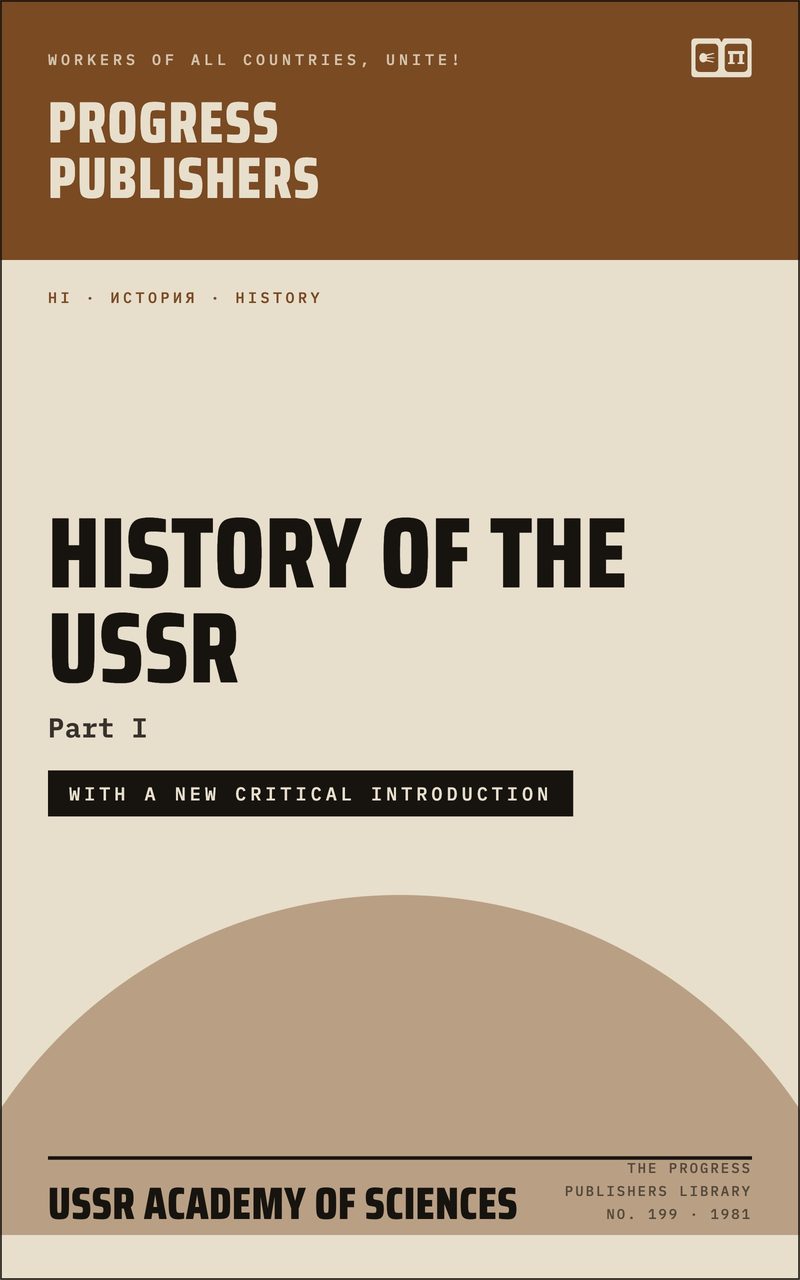
History of the USSR, Part I
Buy
The critical introduction
Written for this edition and published free in Progress Quarterly, Volume VI, Number 4.
Read it the whole numberThe first thing to notice is that this book has authors, and that they are listed.
Its introduction assigns every chapter to a named scholar: D. P. Kallistov on the earliest period, I. I. Smirnov with A. I. Kopanev and N. A. Kazakova, N. Y. Nosov, A. G. Mankov and I. P. Shaskolsky, M. P. Vyatkin - whose chapters were supplemented after his death - then S. S. Volk, Sh. M. Levin and R. Sh. Ganelin. The sections on culture are credited to D. S. Likhachov, the most distinguished student of Old Russian culture of his generation.
Set that against the 1938 Short Course, which named no author and announced instead that it had been edited by a commission of the Central Committee and authorised by the same body. Between those two title pages lies the whole of what de-Stalinisation did to Soviet history writing. A history is no longer the decision of a governing body; it is the work of academics, most of them Leningrad specialists, several of them serious in ways that survive translation.
Part One runs from the earliest times to 3 March 1917 - Kievan Rus, the Mongol conquest, Muscovy, the empire, serfdom and its abolition, the revolutionary movement, 1905, the war and the February revolution. As a one-volume Soviet account of the Russian past by named specialists it is the standard export text.
Prepared by the Institute of History of the USSR Academy of Sciences; first Russian edition 1963.
Part One of three.
New critical introduction by Dmitry Chasovennikov.
| Series | The Progress Publishers Library |
| First published | 1981 |
| ISBN | 978-5-01-900056-2 |
| Pages | 376 |
| Language | English |
| Subject | History |
| Introduction By | Dmitry Chasovennikov |
| Translator | George Herbert Hanna |