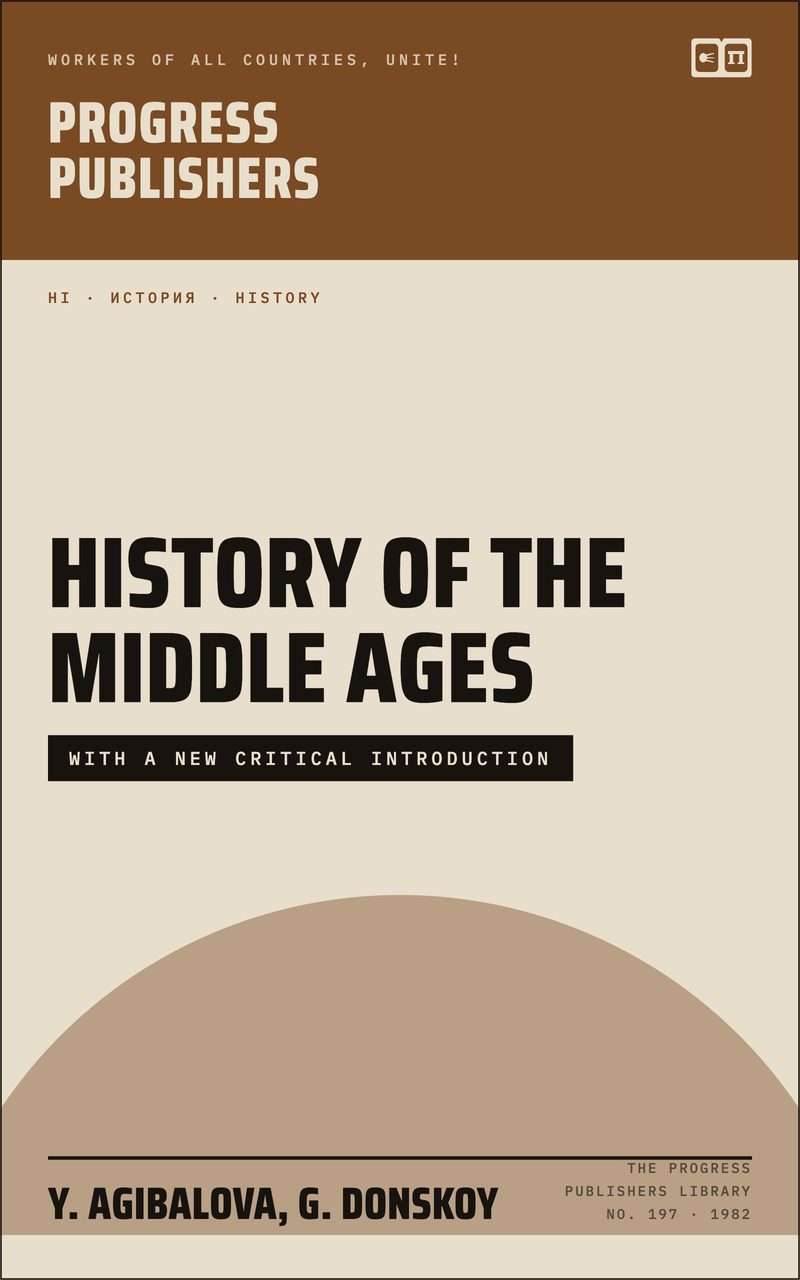
History of the Middle Ages
Buy
The critical introduction
Written for this edition and published free in Progress Quarterly, Volume VII, Number 1.
Read it the whole numberThis is a schoolbook, and its interest is that it was the schoolbook. History of the Middle Ages was the standard Soviet secondary-school textbook on the medieval world - the volume from which tens of millions of Soviet children learned what the thousand years between the fall of Rome and the discovery of America had been about. It was awarded the State Prize of the USSR in 1978. Progress Publishers issued it in English in 1982.
To read it is to watch the Marxist account of world history being taught not to cadres or to sympathetic foreigners but to twelve-year-olds, as their ordinary schooling. What it chose to teach them was, in its broad outline, a serious and humane thing: that history is made by those who labour, that the wealth of the powerful is drawn from the poor, that the medieval world was the whole world and not merely Christendom, and that the exploited fought back in every age.
Where a Western textbook of the same year would organise the medieval centuries around dynasties, this one organises them around uprisings, and it plainly relishes them. The Jacquerie of 1358 gets a full section, its peasants credited with a clarity the book admires: "the insurgents knew who their enemies were - the feudal lords." Wat Tyler's rising of 1381 gets a chapter to itself, John Ball released from prison to lead beside him, the rebels demanding that the Church's lands be divided among the peasants, the king breaking his word the moment the danger passed. The Hussite wars in Bohemia are read as a peasant war, longer and better organised than the English and French risings. The German Peasant War of 1525 is the culmination. And the sequence is deliberately worldwide - the same section that treats Europe carries the rebellion of Huang Chao in ninth-century China - so that the child sees the class struggle as a law of the feudal world rather than a local European accident.
The classroom apparatus is intact: the direct address to the pupil throughout, numbered study questions closing every section, and the "Request to Readers" asking the child's opinion of the book, its translation and its design.
New critical introduction by Dmitry Chasovennikov.
| Series | The Progress Publishers Library |
| First published | 1982 |
| ISBN | 978-5-01-900223-8 |
| Pages | 320 |
| Language | English |
| Subject | History |
| Introduction By | Dmitry Chasovennikov |
| Translator | Natalia Belskaya |