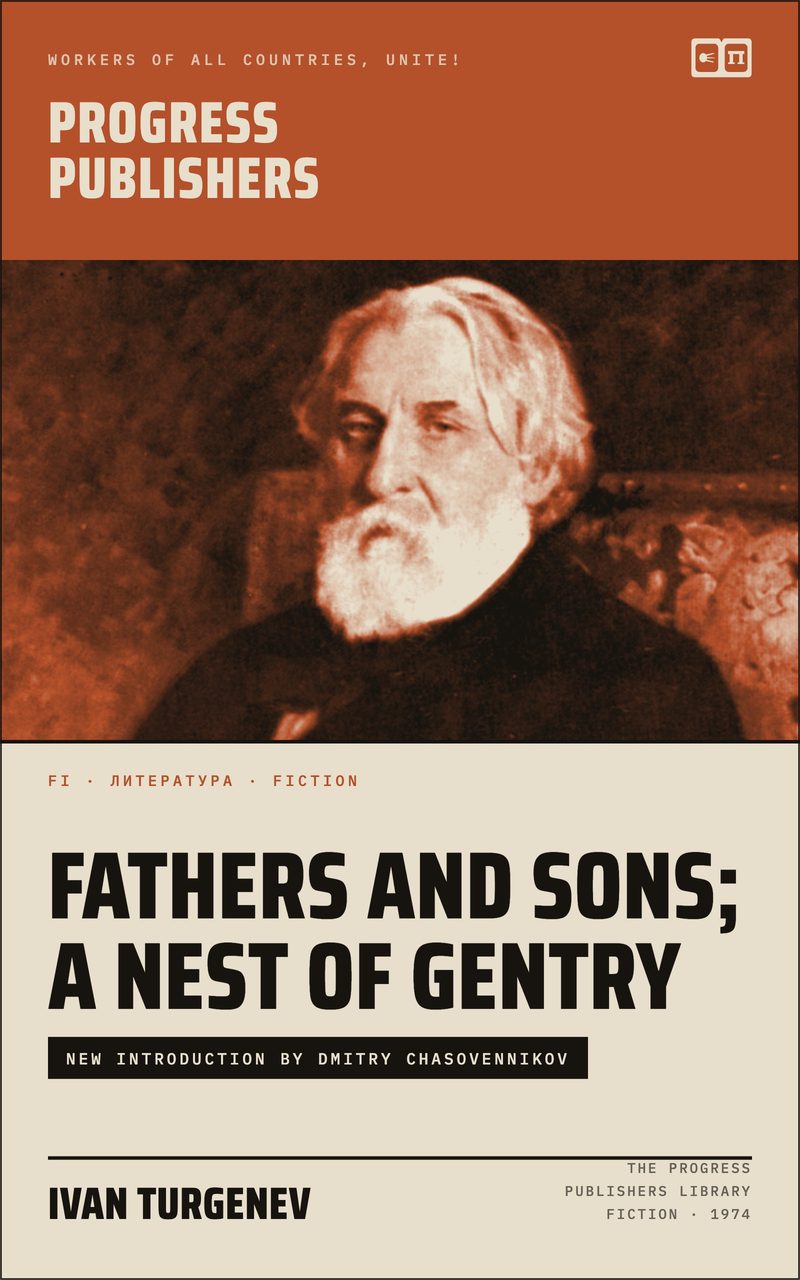
Fathers and Sons; A Nest of Gentry
Buy
The critical introduction
Written for this edition and published free in Progress Quarterly, Volume IX, Number 4.
Read it the whole numberA word enters the language at a breakfast table. "He is a nihilist." "A what?" - and Pavel Petrovich stops dead, his knife with a dab of butter on the tip arrested in mid-air.
The butter on the knife is why Turgenev is Turgenev. A generation is being announced, and what the novelist watches is a middle-aged gentleman's hand stopping in the air above his toast.
Fathers and Sons appeared in 1862, the year after the serfs were emancipated, and did something very few novels have done: it named a political type that did not yet know it had a name, and the type took the name up. Within months nihilist was in the newspapers and the police reports. Pisarev read it and found a hero; Antonovich read it and found a libel on the young. Both were reviewing the same pages.
What survives is the refusal to resolve. Turgenev would not do what either critic demanded, which was to declare. Bazarov is the record of a correct negation with nothing to attach itself to - a man who saw through liberalism, populism and propaganda and had, in consequence, nothing whatever to do.
With A Nest of the Gentry (1859), in which a landowner's great-grandfather hanged serfs by the ribs and his grandfather was one. Nobody has ever been harder on that class, and Turgenev was of it.
Progress Publishers, Russian Classics Series, 1974. Translated by Bernard Isaacs.
New critical introduction by Dmitry Chasovennikov.
| Series | The Progress Publishers Library |
| First published | 1974 |
| ISBN | 978-5-01-900326-6 |
| Pages | 428 |
| Language | English |
| Subject | Fiction |
| Introduction By | Dmitry Chasovennikov |