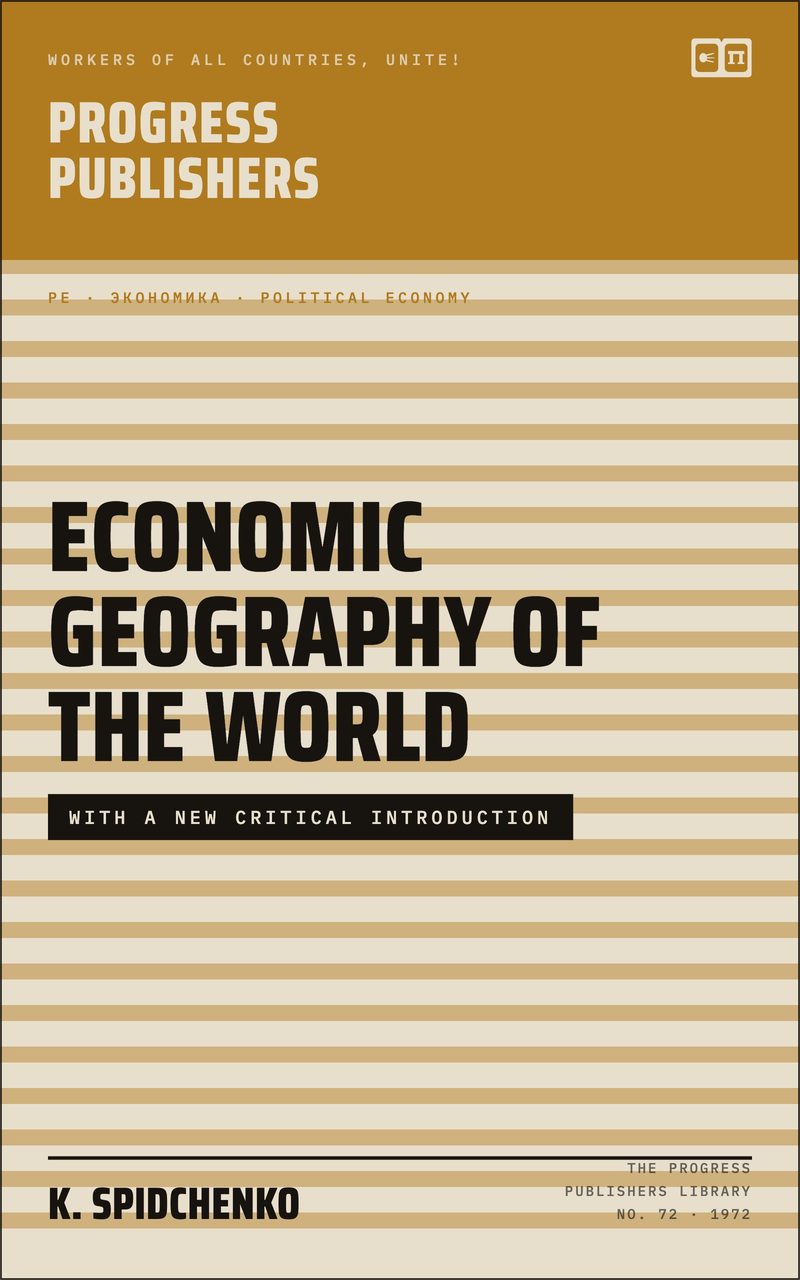
Economic Geography of the World
Buy
The critical introduction
Written for this edition and published free in Progress Quarterly, Volume II, Number 4.
Read it the whole numberA geography textbook seems the least ideological of books. It counts tons of steel and kilometres of railway, lists rivers and populations, and says which country grows the most cotton. K. Spidchenko's survey of the whole inhabited planet does all of this competently and often vividly, for the general reader and the classroom. But it opens not with a map or a river but with the October Revolution, and its real subject is not the distribution of industry across the earth. It is the claim that the earth is divided into two systems, and that one of them is winning.
The doctrine is stated flatly: states are either bourgeois or socialist depending on their social system, with the developing countries a way-station rather than a third term. The two systems are not described in the same language, and the asymmetry is the argument. The capitalist world is the realm of unevenness, waste and rivalry; the socialist world is the realm of plan and proportion.
Its value now is as a snapshot with a precise date and no lag. Spidchenko cites the Twenty-Fourth Congress of 1971 as recent, counts more than seventy new states formed between 1945 and 1972, notes the resumption of American bombing in North Vietnam that year, and writes of Chile - in the present tense, hopefully - that it has taken the road of far-reaching reform following the 1970 presidential election. The coup was fourteen months away. This is the Soviet world-picture at the high-water mark of detente, rendered into English and sent abroad to be believed, with every figure and claim set out plainly enough to be checked.
Translated by David Fidlon. New critical introduction by Dmitry Chasovennikov.
| Series | The Progress Publishers Library |
| First published | 1972 |
| ISBN | 978-5-01-900069-2 |
| Pages | 188 |
| Language | English |
| Subject | Political Economy |
| Introduction By | Dmitry Chasovennikov |
| Translator | David Fidlon |