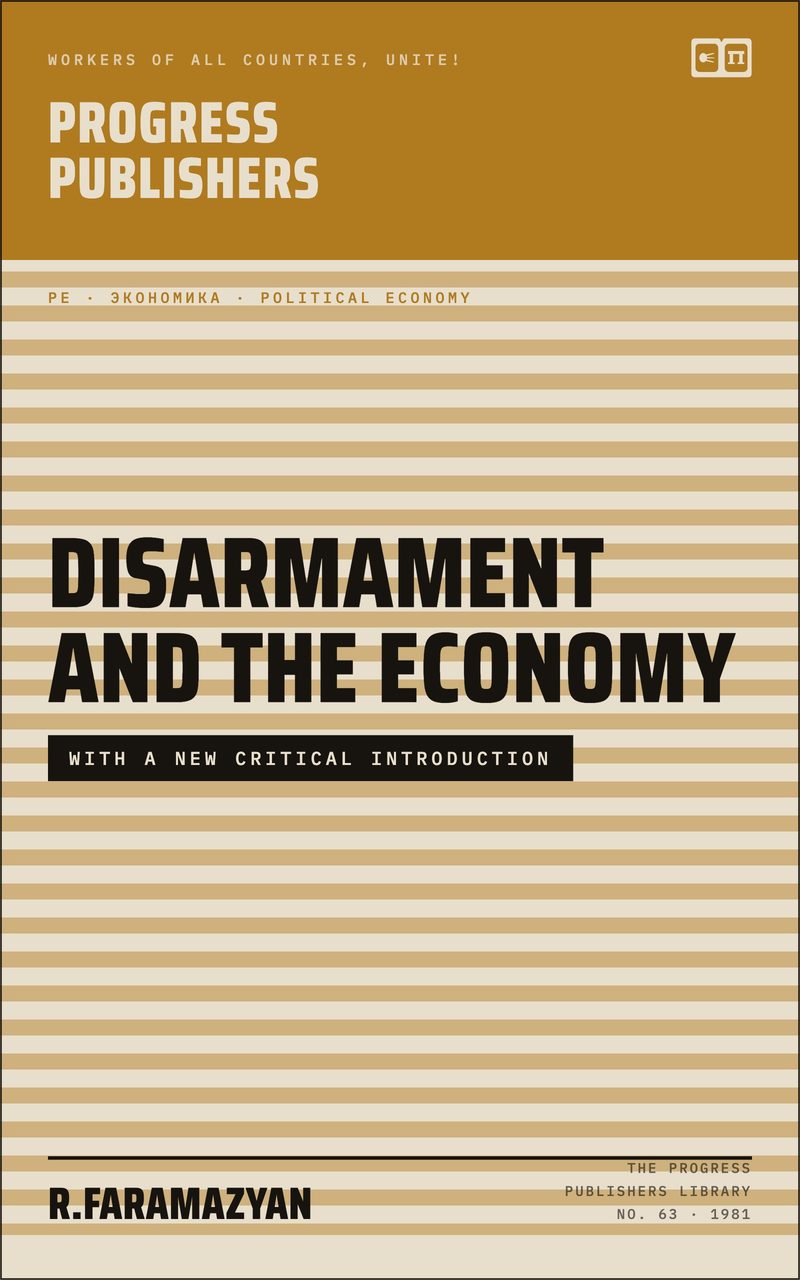
Disarmament and the Economy
Buy
The critical introduction
Written for this edition and published free in Progress Quarterly, Volume VI, Number 4.
Read it the whole numberA professional economist's account of what arms spending does to an economy, written at the Institute of World Economy and International Relations - the Soviet Union's premier think-tank on the capitalist world.
Rachik Faramazyan wears his scholarship openly. He draws on the SIPRI yearbooks, on United States government statistics, on the work of American defence economists including Murray Weidenbaum and Kenneth Boulding, and on the American press. The apparatus is real and most of what it produces is sound.
The core is a critique of military spending as economic waste, and on that ground the book remains citable. Its central proposition is that arms expenditure is a deduction from the national product rather than an addition to it: that the resources absorbed by weapons are withdrawn from investment and consumption, that the multiplier claimed for defence contracts is smaller than its advocates allege, and that the research talent drawn into military work is the scarcest resource of all. The chapters on the conversion problem - what an economy would actually have to do to turn military capacity to civil use - are the most substantial treatment of the question available from a Soviet author in English.
For once the imprint is honest, and that is the difficulty. Faramazyan quotes the Twenty-Sixth Congress of February and March 1981 as current, with tables running to the 1980-81 American defence budget - which means the book was finished exactly as the world it describes came apart.
New critical introduction by Dmitry Chasovennikov.
| Series | The Progress Publishers Library |
| First published | 1981 |
| ISBN | 978-5-01-900119-4 |
| Pages | 172 |
| Language | English |
| Subject | Political Economy |
| Introduction By | Dmitry Chasovennikov |
| Translator | Joseph Shapiro |