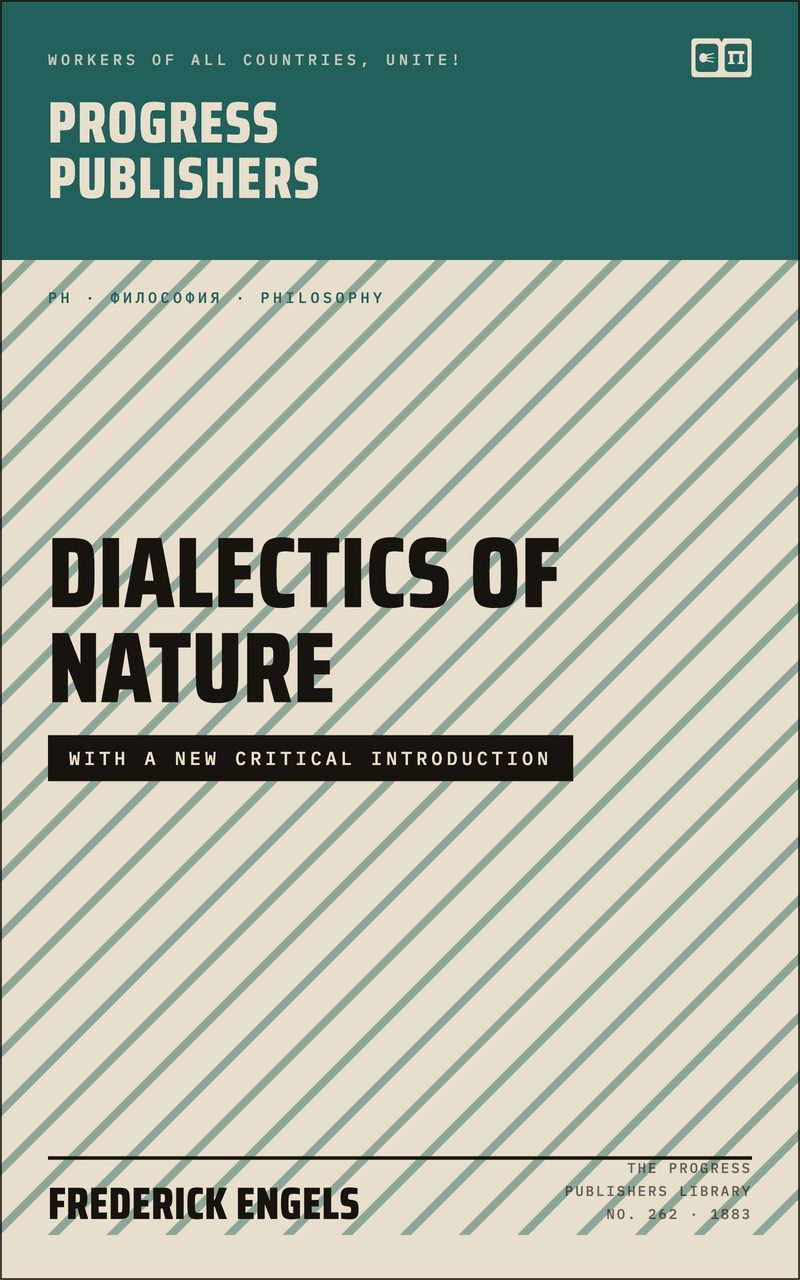
Dialectics of Nature
Buy
The critical introduction
Written for this edition and published free in Progress Quarterly, Volume I, Number 2.
Read it the whole numberDialectics of Nature is not a book Engels wrote. It is a book the twentieth century made out of papers he left.
Between 1873 and 1883 he filled four folders with articles, half-finished chapters, plans and loose notes on the natural sciences, meaning one day to draw them into a work that would do for nature what the materialist conception of history had done for society. He never did. In 1876 he broke off to answer Eugen Duehring, and Anti-Duehring took the years he might have spent finishing this; then Marx died, and bringing out the unpublished volumes of Capital took the rest. The folders went into a drawer, and were first published in Moscow in 1925 by David Ryazanov's Marx-Engels Institute.
What Engels was attempting was ambitious and, at its best, admirable. He wanted to rescue the natural science of his day from the crude mechanical materialism that treated the world as so much matter pushed about by external force, without falling back into the idealism that made mind or spirit the author of nature. His instrument was the classification of what he called the forms of motion of matter - mechanical, physical, chemical, biological - each higher form arising out of the lower and irreducible to it. "A pure change of place is the lowest form of motion, while thought is the highest."
That anti-reductionist core is the living centre of the book and has worn far better than most nineteenth-century natural philosophy. It speaks directly to a present crowded with attempts to dissolve the human into the neural and the neural into the algorithmic. So does the ecological Engels, warning that nature takes its revenge on those who imagine they have conquered it - a passage being read again by people who need exactly his combination of materialism and warning.
Translated by Clemens Dutt. New critical introduction by Dmitry Chasovennikov.
| Series | The Progress Publishers Library |
| First published | 1883 |
| ISBN | 978-5-01-900243-6 |
| Pages | 363 |
| Language | English |
| Subject | Philosophy |
| Introduction By | Dmitry Chasovennikov |
| Translator | Clemens Dutt |