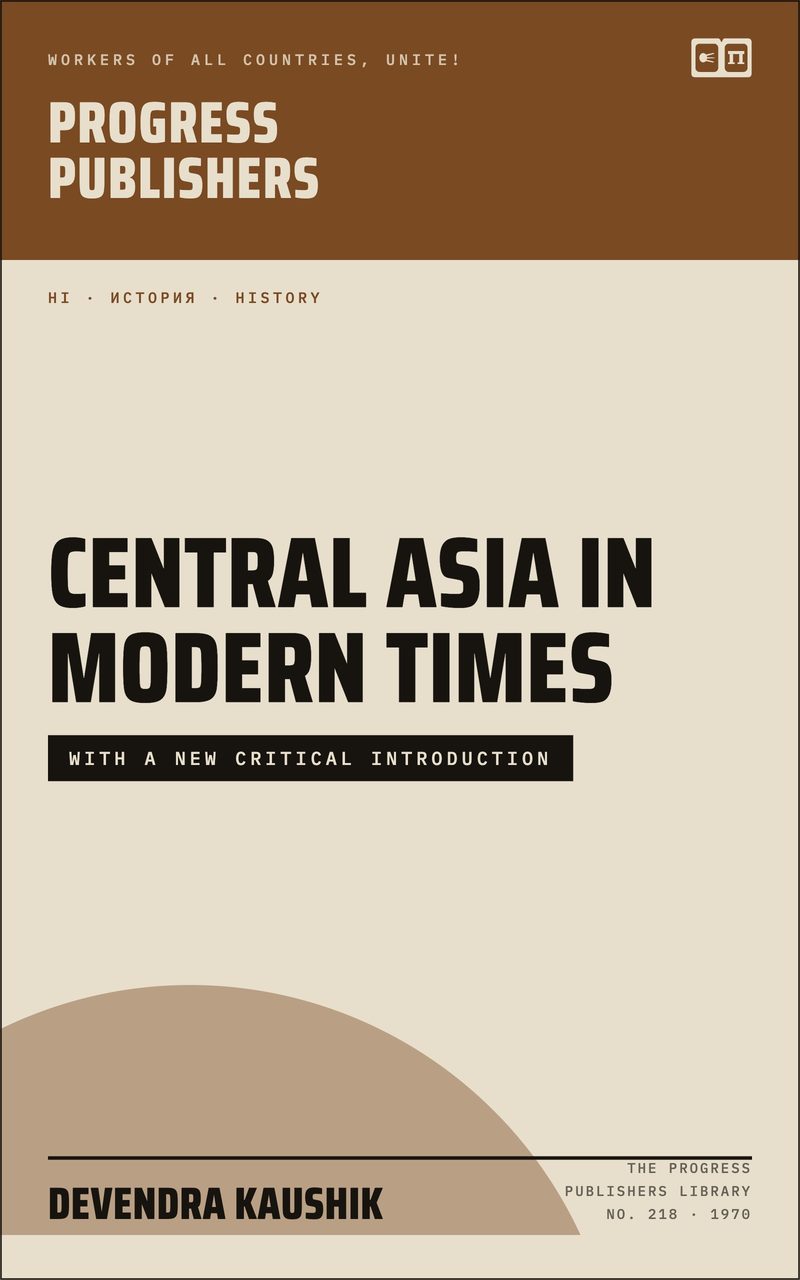
Central Asia in Modern Times
Buy
The critical introduction
Written for this edition and published free in Progress Quarterly, Volume II, Number 2.
Read it the whole numberAlmost every volume in this series was written inside the Soviet system by authors it had formed. This one was written by an outsider who admired it.
Central Asia in Modern Times is the work of Devendra Kaushik, an Indian Marxist historian who came to the subject from New Delhi rather than from Moscow or Tashkent. He held a fellowship at the Lenin State University in Tashkent from 1962 to 1965 and worked in the Indian archives as well as the Soviet ones, and that difference of standpoint is the most interesting thing about the book.
It is a real and valuable history. Kaushik gives the best Indian-archival account of the Great Game of his generation - the Anglo-Russian rivalry over the khanates read from the records of the other side of it - and a clear-eyed Marxist anatomy of the Tsarist colonial economy in Turkestan: the cotton monoculture, the settler question, the transformation of the region into a supplier for Russian industry. He is also an honest recorder of what changed after 1917: literacy, medicine, the unveiling, the end of the emirates.
Date the argument rather than the spine. The English edition carries a 1970 copyright, but the preface is signed from New Delhi in January 1968 and the book reads as a document of the middle 1960s - its running statistics lean on the 1959 census, its Tashkent research belongs to 1962-65, and it was written before the tanks entered Prague. It belongs to the high season of Soviet-Indian friendship, the years of the Tashkent Declaration.
New critical introduction by Dmitry Chasovennikov.
| Series | The Progress Publishers Library |
| First published | 1970 |
| ISBN | 978-5-01-900202-3 |
| Pages | 200 |
| Language | English |
| Subject | History |
| Introduction By | Dmitry Chasovennikov |