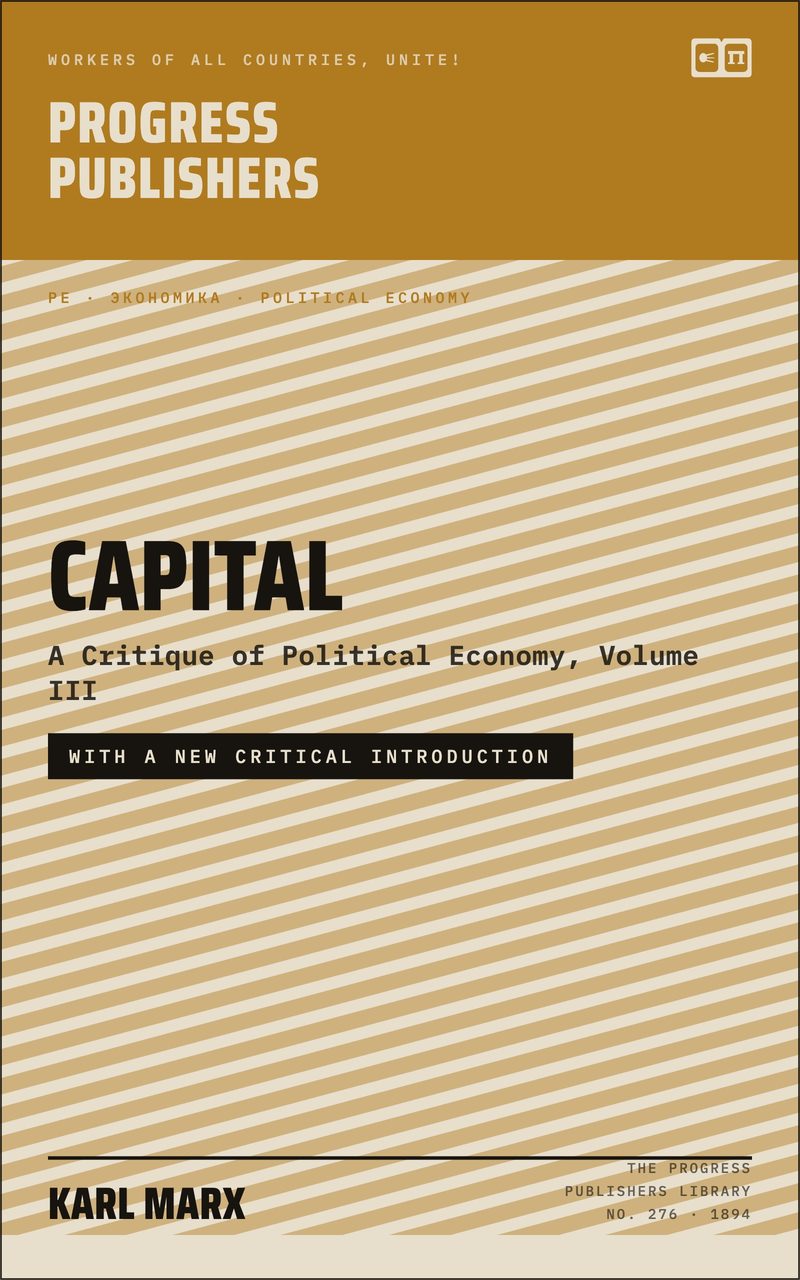
Capital: A Critique of Political Economy, Volume III
Buy
The critical introduction
Written for this edition and published free in Progress Quarterly, Volume VI, Number 2.
Read it the whole numberVolume Three is where Capital comes up for air.
The first volume went down into what Marx called the hidden abode of production and found the secret of surplus value; the second followed that value as it circulated; the third climbs back to the surface, to the daylight world of profit, interest and rent, and shows how the laws worked out in the depths appear - disguised, inverted, almost unrecognisable - in the ordinary consciousness of businessmen and economists.
It is the volume that speaks the language of the balance sheet, the bank and the landlord's rent-roll, and for that reason the one a reader can open almost anywhere and feel a shock of recognition. The transformation of surplus value into profit, the tendency of the rate of profit to fall, merchant capital, interest-bearing capital and credit, ground rent, and the closing chapter on classes that breaks off mid-sentence.
Marx drafted the manuscript in 1864 and 1865, before Volume One was even in print, and then left it. After his death it took Engels the better part of a decade to make a book of the fragments, published in 1894.
Engels was candid about the state of what he had been left: not a manuscript needing tidying but a great unfinished argument, some chapters sketched, others broken off, the reasoning sometimes polished and sometimes only indicated. He ordered it, filled gaps and smoothed transitions, and that labour is the only reason the book exists at all.
New critical introduction by Dmitry Chasovennikov.
| Series | The Progress Publishers Library |
| First published | 1894 |
| ISBN | 978-5-01-900280-1 |
| Pages | 1142 |
| Language | English |
| Subject | Political Economy |
| Introduction By | Dmitry Chasovennikov |