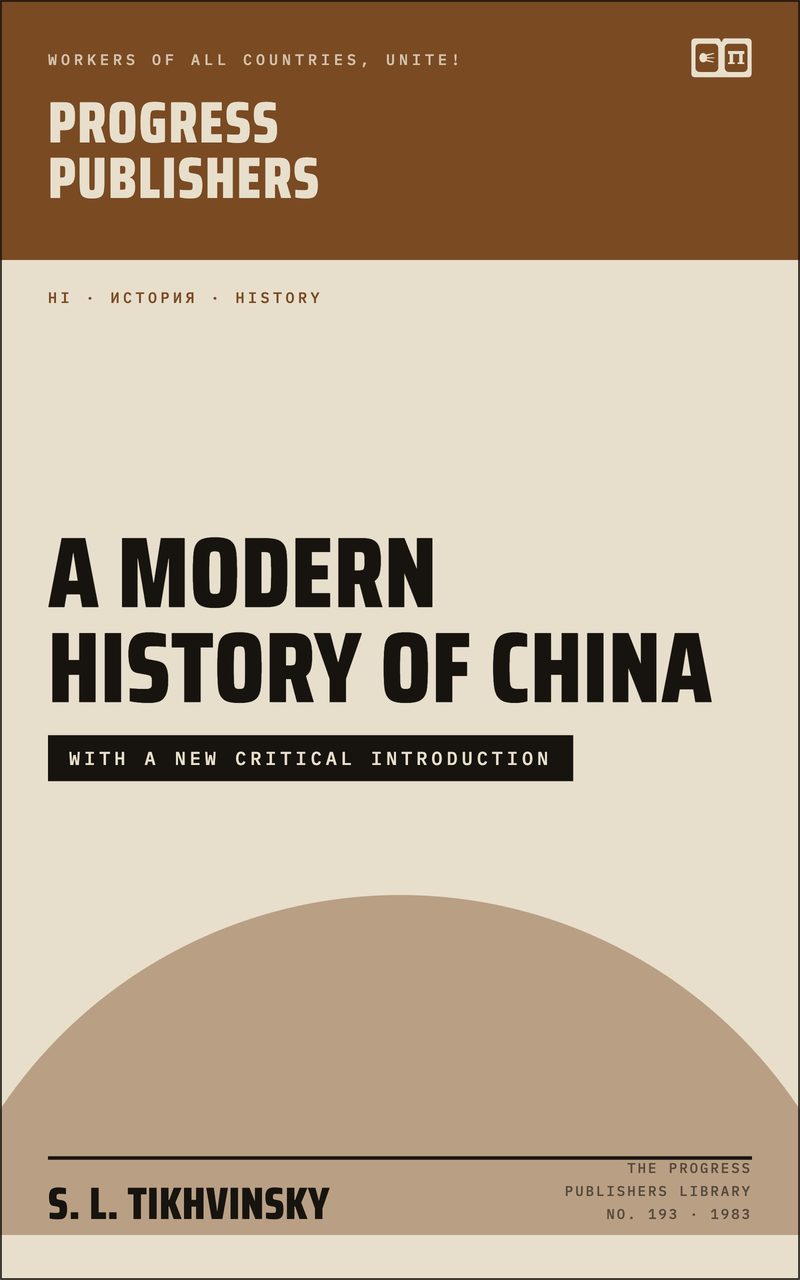
A Modern History of China
Buy
The critical introduction
Written for this edition and published free in Progress Quarterly, Volume VII, Number 3.
Read it the whole numberA large and learned collective history taking the reader from the Manchu conquest of 1644 to the eve of the May Fourth Movement.
It is the product of the modern-history group of the China Division of the Institute of Oriental Studies: eighteen chapters shared among named specialists, most holding the Candidate of Historical Sciences degree, each writing on the period of their own research, under the general editorship of Sergei Tikhvinsky.
Tikhvinsky was not a marginal figure working under sufferance. He was a Corresponding Member of the Academy of Sciences and a career diplomat who had served in China, and by the 1970s the discipline of Soviet sinology largely ran through him. This is the considered account of China's modern past issued by the scholarly arm of the Soviet state, and on the Opium Wars, the Taiping rebellion, the unequal treaties, the self-strengthening movement, the Boxer rising and the revolution of 1911 it carries a weight of research available nowhere else in English.
Its context is unavoidable and gives it much of its interest. The Russian original appeared in 1972, three years after Soviet and Chinese troops had fought a shooting war over an island in the Ussuri - the same river whose boundary the book takes such trouble to explain. It closes on the editor's hope that the volume will contribute to friendship between the two peoples, written while the two states were massing armies along the longest border in the world.
New critical introduction by Dmitry Chasovennikov.
| Series | The Progress Publishers Library |
| First published | 1983 |
| ISBN | 978-5-01-900231-3 |
| Pages | 891 |
| Language | English |
| Subject | History |
| Introduction By | Dmitry Chasovennikov |
| Translator | Vic Schneierson |