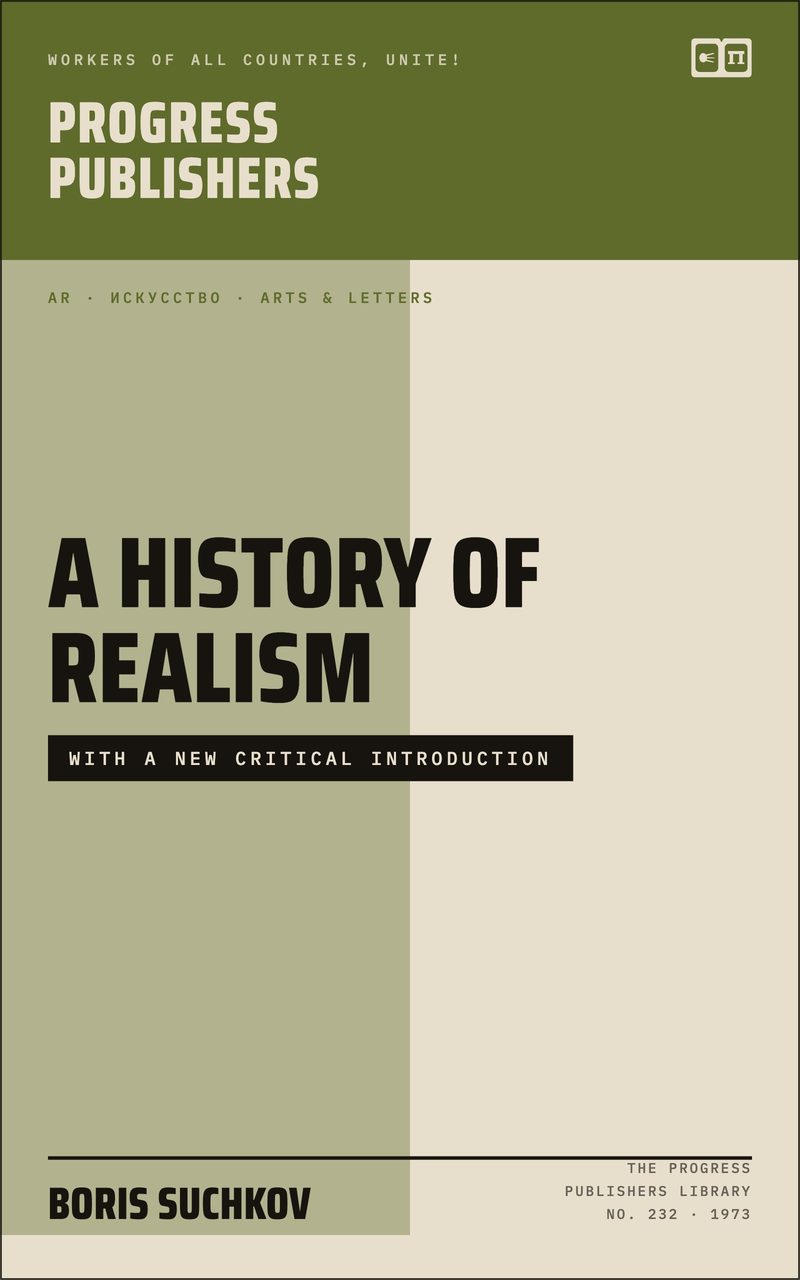
A History of Realism
Buy
The critical introduction
Written for this edition and published free in Progress Quarterly, Volume III, Number 2.
Read it the whole numberThe English title is the publisher's invention. The Russian one - the historical destinies of realism - is more honest, because this is not a history but three long essays: on what realism is, on realism from the Renaissance to Tolstoy, and on the realism of the twentieth century. Boris Suchkov is arguing a single thesis at book length, and the thesis is worth arguing with.
What distinguishes him is that he reads, and reads in the original. Balzac in a Brussels edition of 1831, Bulwer-Lytton, Nietzsche in German, Sartre's L'etre et le neant in the Paris edition of 1943 with a page number, Jaspers, Heidegger, Stefan Zweig, Winckelmann, Thomas Mann, and the proceedings of the 1938 Paris conference of the International Association of Writers for the Defence of Culture. When he attacks existentialism he attacks it out of its own books, conceding at the outset that the existentialists had given a fairly convincing description of the modern world as it appears to bourgeois perception - which is a thesis rather than a straw man, and obliges him to work for his objection.
The comparative criticism is the best thing in the book. His long parallel between Balzac and Stendhal is genuinely illuminating: Balzac's heroes struggle inside the system and can be reconciled to it, while the conflict between Julien Sorel and his world rests on a class antagonism that will outlast any personal accommodation. He is exact about Balzac's method and the penetration of self-interest into every sphere of private life.
The volume also carries sustained analysis of Gorky, Sholokhov, Fadeyev, Serafimovich and Leonov.
New critical introduction by Dmitry Chasovennikov.
| Series | The Progress Publishers Library |
| First published | 1973 |
| ISBN | 978-5-01-900018-0 |
| Pages | 380 |
| Language | English |
| Subject | Arts & Letters |
| Introduction By | Dmitry Chasovennikov |