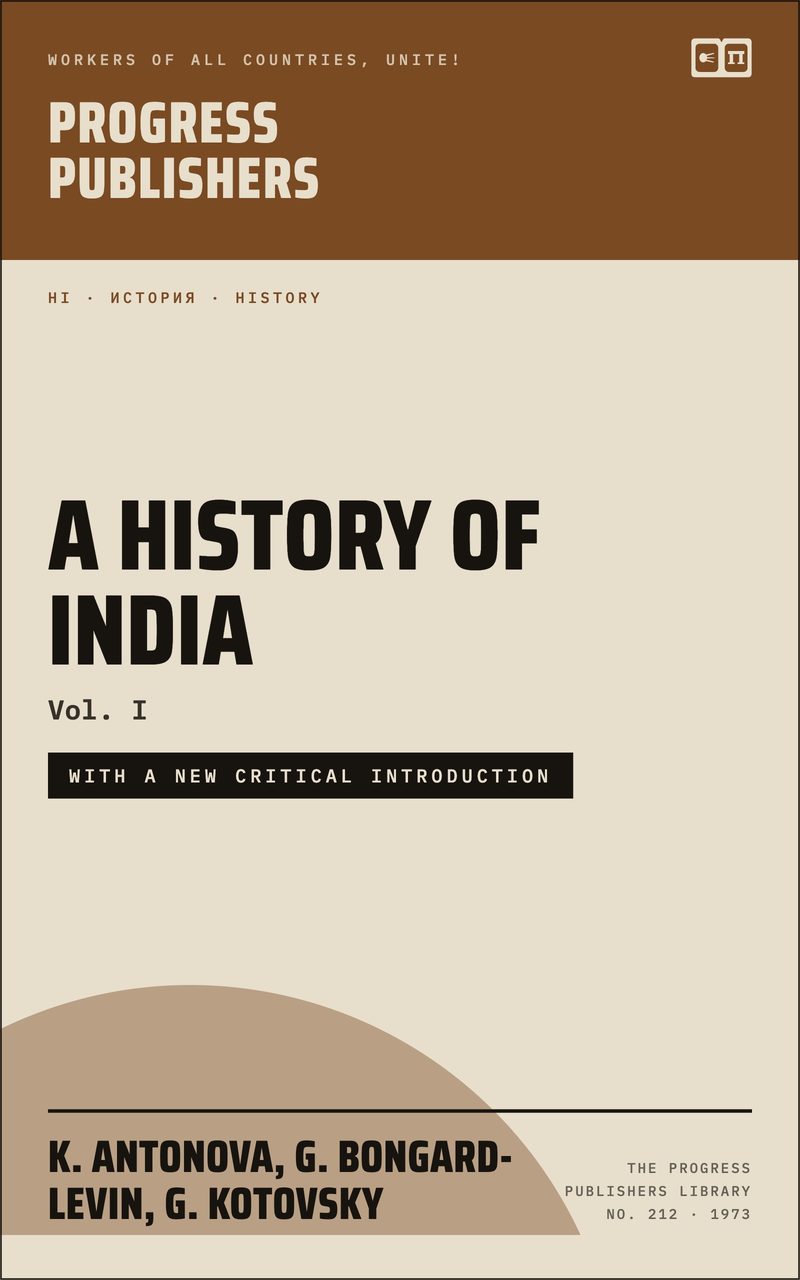
A History of India, Volume I
Buy
The critical introduction
Written for this edition and published free in Progress Quarterly, Volume III, Number 2.
Read it the whole numberA reader who opens this expecting a tract will be disarmed within a few pages. This is a work of real learning, carrying the ancient and medieval history of the subcontinent - the Stone Age, the Harappan cities, the Vedic age, the rise of Magadha, the Mauryan and Gupta empires, and the long medieval centuries through the Delhi Sultanate, Vijayanagar and the Mughals - with a command of the archaeology, the epigraphy and the Sanskrit and Pali sources that few single-volume histories in any language could match.
The first part is by Grigory Bongard-Levin, among the most distinguished Soviet Indologists and Sanskritists; the medieval sections are K. A. Antonova's. Behind them stood the four-volume Soviet History of India compiled between 1959 and 1969, several of whose authors worked on this study too.
Bongard-Levin's chapters on the deep past are the strongest thing here, and their distinguishing mark is a willingness to say the evidence does not settle the question. On who ruled the Indus cities and how, the book lays out the competing hypotheses - a slave-owning order, a priestly-landlord analogy with Mesopotamia, a republican-oligarchic reading - and then declines to choose, because the data are inadequate. That restraint runs through the ancient sections. On the slavery of the Magadha and Mauryan age it draws on specialised Soviet work to reconstruct the categories of bondage, the manumission rules of the Arthashastra, and the price of a slave from the Buddhist texts, with genuine philological care.
Volume One of two. Translated by Katharine Judelson.
New critical introduction by Dmitry Chasovennikov.
| Series | The Progress Publishers Library |
| First published | 1979 |
| ISBN | 978-5-01-900209-2 |
| Pages | 356 |
| Language | English |
| Subject | History |
| Introduction By | Dmitry Chasovennikov |
| Translator | Katharine Judelson |