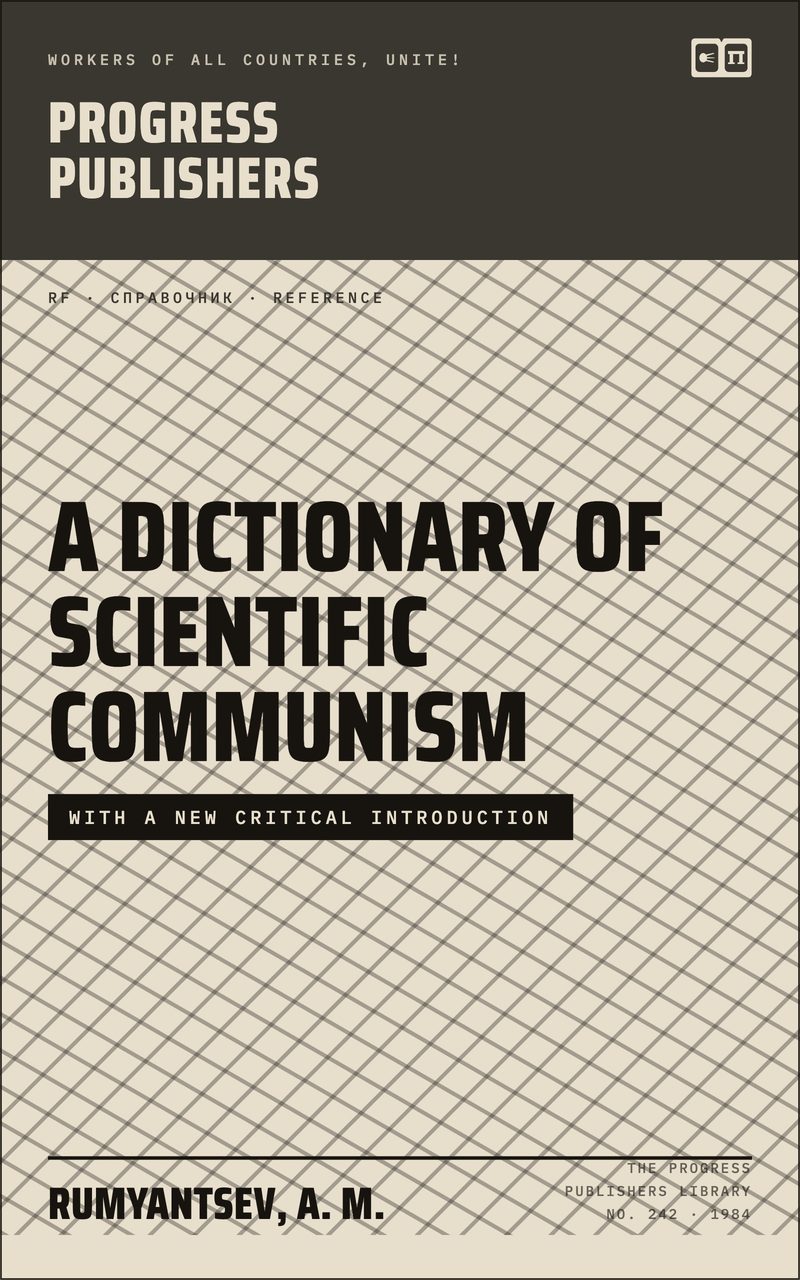
A Dictionary of Scientific Communism
Buy
The critical introduction
Written for this edition and published free in Progress Quarterly, Volume VIII, Number 1.
Read it the whole numberA dictionary makes an unusual polemic, because it does not argue. It assigns. It decides which things in the world are things at all - which deserve a headword, a definition and a settled meaning - and presents the result as the furniture of reality rather than a position taken.
Two hundred and one entries across some hundred and fifty-eight thousand words, edited by A. M. Rumyantsev, an economist and Academy figure who had edited the international theoretical monthly and, briefly, Pravda. It is not the work of a hack but a committee product of the Soviet academic establishment at the top of its form.
What it catalogues needs explaining, because scientific communism was not a literary genre but an institution. From the early 1960s it was a compulsory subject in every Soviet higher-education establishment: engineers, doctors, agronomists and philologists all sat examinations in it, and it had chairs, departments, dissertation councils and career ladders. This is the crib for that nationwide curriculum, exported in English for foreign students and sympathetic libraries.
The volume is candid about its own character. Its entry under the headword describes a science with its own laws and categories, the most immediately connected of the three components of Marxism-Leninism with practical revolutionary struggle - and then adds that it is a profoundly partisan science.
Almost nothing in it is a lie of the simple sort. The interest is in the architecture.
The text is of 1983: its latest citations are the Warsaw Treaty declaration at Prague that January and the Law on Work Collectives.
New critical introduction by Dmitry Chasovennikov.
| Series | The Progress Publishers Library |
| First published | 1984 |
| ISBN | 978-5-01-900003-6 |
| Pages | 288 |
| Language | English |
| Subject | Reference |
| Introduction By | Dmitry Chasovennikov |